This museum visit recap was originally intended for our paid subscribers, however, in observance of the national strike, this article will be free to all members. Please enjoy.
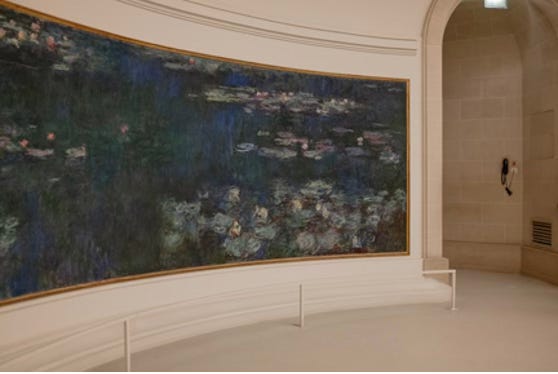
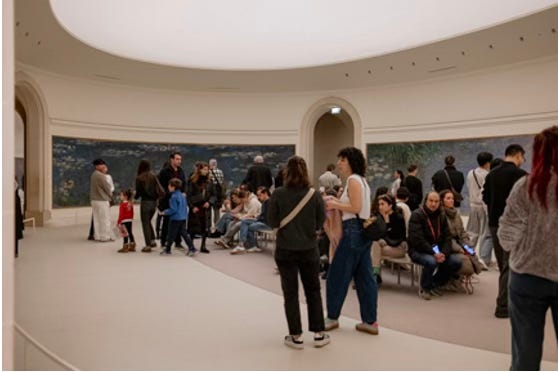
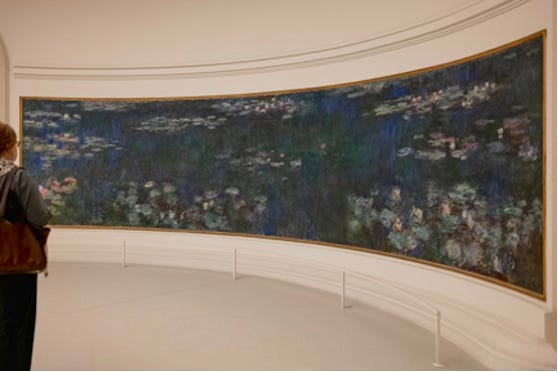
This past winter, I had an incredible opportunity to visit the Musée l'Orangerie in Paris, France, to witness Claude Monet’s The Water Lilies. My expectation was that there would be one big room. However, there were two rooms in the building for his series— eight compositions, four in each room. I also learned that Monet designed this viewing space himself, stating that his intention was to provide the viewer with the “illusion of an endless whole, of a wave without horizon and without shore.” Even the sunlight coming in from the center of the ceiling washes the room with light that is muted with many layers. You can take a virtual tour here.
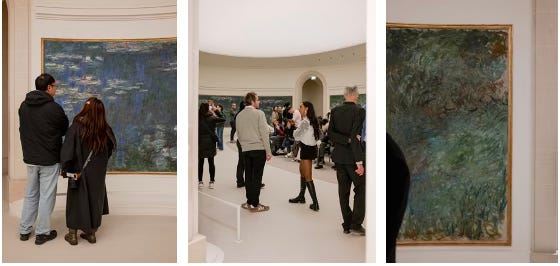
Monet expressed a profound sense of guilt about making art while World War I was raging around him, just miles from his home in Giverny. At the same time, he was grieving the loss of his son and wife while his country was being torn apart. In a letter from 1914, he wrote: “Yesterday I resumed my work. It’s the best way to avoid thinking of these sad times. All the same, I feel ashamed to think about my little researches into form and colour while so many people are suffering and dying…” Yet, he created these beautiful pieces of beauty and tranquility.
In times of sustained turbulence, the act of creating or seeking out beauty isn’t escapism; it’s a form of preserving what makes life worth living. Monet created the The Water Lilies to offer a “haven of peaceful meditation.” Today, they are permanently housed in the Musée de l’Orangerie as a symbol of peace and beauty, memorializing the end of WWI.
Some other notable artists who created through difficult circumstances include Frida Kahlo, who dealt with lifelong pain from a devastating bus accident and polio. Still, she created some of her most powerful self-portraits while bedridden or recovering from surgeries. Francisco Goya continued painting afer becoming deaf in his 40s and produced his haunting “Black Paintings” during Spain’s tumultous political upheaval and his own isolation. Ai Weiwei created art while facing government surveillance, detention, and censorship in China, using his work to advocate for human rights despite personal risk. Käthe Kollwitz created profound works about war, poverty, and loss in early 20th century Germany, even continuing to create as she lost her son in WWI.
These artists show how creativity can not only survive adversity but can be deepened and refined by it. Their struggles often became integral to their artistic vision rather than obstacles to overcome.
We share this article now in response to simliar doubts and questions rising from artists during this tense political climate. We hear “does art even matter right now?” and “how do I create when all of this is going on?” To that, we (including Monet) would all remind you: art doesn’t only matter now, it matters now more than ever.