Nicole Rademacher, a Los Angeles–based conceptual artist and clinician (ATR-BC, LMFT), works across media, including video, collage, and participatory work. Her work has been shown at Transmediale, LOOP, and Los Angeles International Airport. She has developed a museotherapy model combining deep looking, somatic awareness, and reflective art-making, piloted at LACMA and adapted for the Wignall Museum of Contemporary Art and more recently brought to the Getty Research Institute. Her 2026 exhibition, The sky broke when I was allowed to fly. / Se rompió el cielo cuando me dejaron volar. at LA Artcore in Los Angeles, included aún sin título, a five-hour gathering co-facilitated with traci kato-kiriyama, where the work the participants created during the gathering was installed in the show.
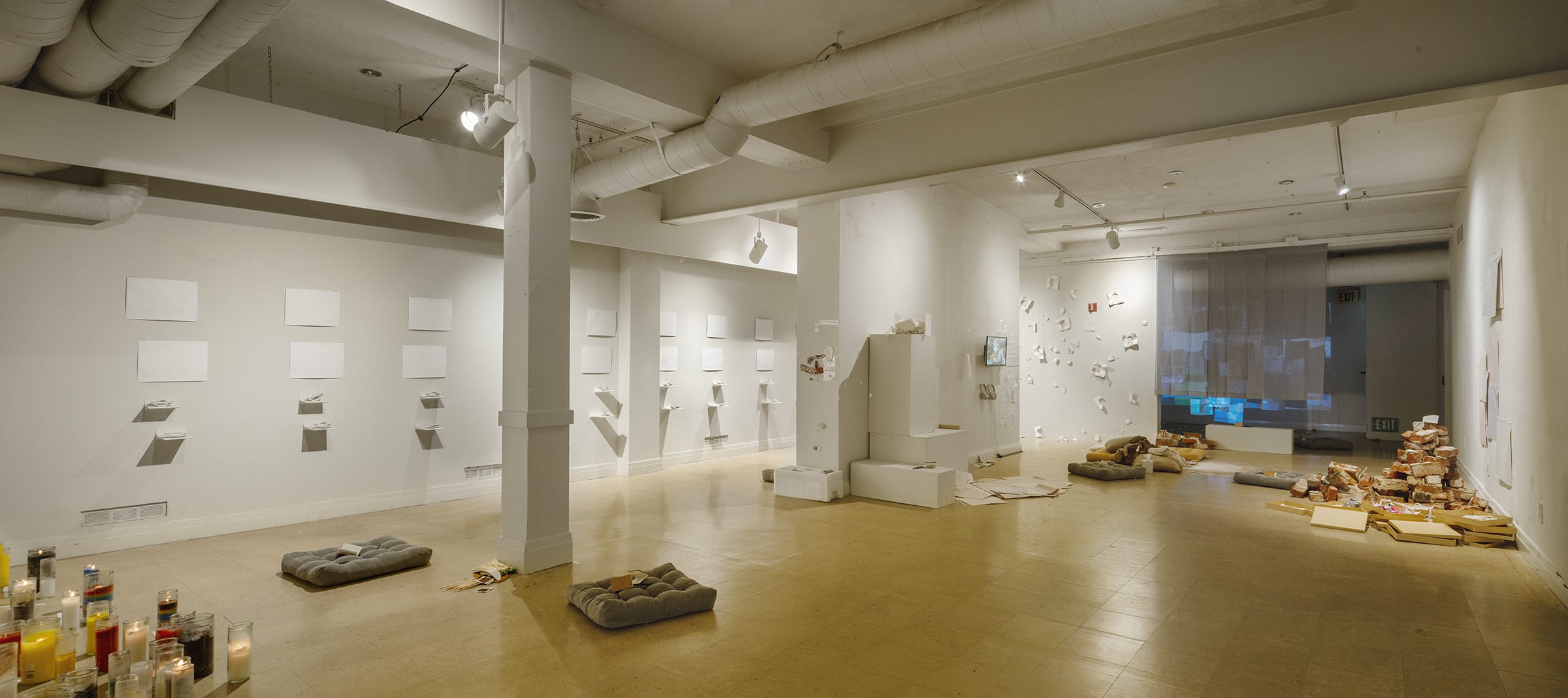
Nicole Rademacher, The sky broke when I was allowed to fly. / Se rompió el cielo cuando me dejaron volar., Installation view. LA Artcore, Los Angeles. Photo by Panic Studios LA. Courtesy of Nicole Rademacher.
Please start with telling us a little about yourself, your path to working with museums, what that experience has been like for you, and where you're hoping museotherapy will go.
I came to museums first as an artist. My foundation is contemporary art and time-based practice.
My artistic practice became more outwardly participatory, and I began to realize what the invitations carried: trauma, memory, identity. Years of teaching youth-focused art programming had not prepared me to hold what I was asking participants to enter. That was the full push to pursue clinical training, and in 2021 I finished my MA at Loyola Marymount University.
To be 100% honest, I don’t remember exactly when I first heard about museotherapy, but I began researching it intentionally in the spring of 2022, before I was fully licensed. At that time, doing clinical work in museums felt like a no-brainer to me. During that research I contacted several museotherapy pioneers, the first being Stephen Legari. His work at the Musée des beaux-arts de Montréal has been an important reference point for museum-based art therapy at institutional scale. He was generous with his time and helped me think more carefully about how I was entering the field.
The first place I tested an early version of the model I was developing was not a museum. In December 2022, I led a walking tour, reflection, and discussion workshop around Joseph Young’s Topographical Map in downtown Los Angeles, as part of Illuminate LA, an LA County Department of Arts and Culture initiative designed by Anuradha Vikram. The workshop was free and open to the public. What happened in that workshop shaped the pilot I ran six weeks later at LACMA, at the invitation of Chelo Montoya. At that time, because museums have such a long history of programs that look very similar on the surface, I wanted the difference to be structural: a clinician facilitating, community guidelines set at the start, and Westmont Counseling Center co-presenting.
I adapted the model for the Wignall Museum of Contemporary Art in 2023 and 2024 at the invitation of Rebecca Trawick, and in February 2026 Suzanne Hudson invited me to facilitate a museotherapy session as part of her Art, Therapy, and the Problem of Repair consortium at the Getty Research Institute.
Each iteration moved the model. The site, the artwork, the participants, and the ethical demands of each encounter changed what it could be. The distinction I now hold between a therapeutic experience and psychotherapy is something I arrived at across those iterations. I did not bring it with me.
As for where it will go, because museums already know how to build safeguards around what they value, I hope they build frameworks for programs that ask participants to do more than look: mindfulness in front of a specific artwork, inside an exhibition, or in the museum generally. Those invitations can open something in a participant.
And for me, I am at the first pass of my inquiry. Some configurations are clear: using a museum’s digital archive, screen-shared inside a virtual session, within a private clinical container. Others are blurrier: who else is in the room, what the institution knows, what happens afterward to what gets made. I am making a compass for those decisions rather than a rule for them, and I keep checking myself there because I want the practices to stay in relation without collapsing into one another.
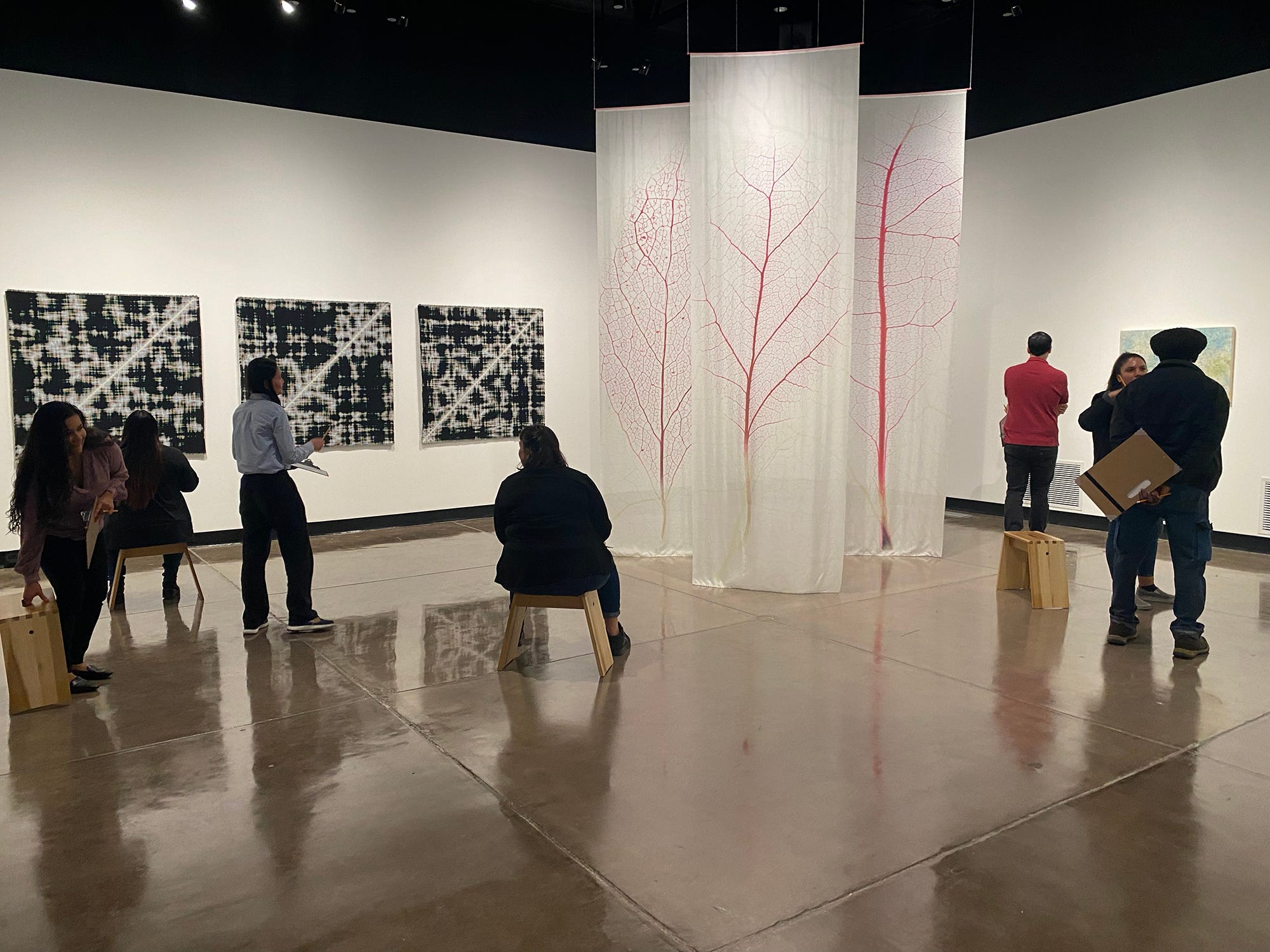
Nicole Rademacher, Experience Art as Therapy, museotherapy program, Wignall Museum of Contemporary Art, Chaffey College, Rancho Cucamonga, 2023. Participants move through deep looking and reflective response in the gallery space, Seeing the Unseen: Science + Art; curated by Chaffey College Professors Joann Eisberg, Robin Ikeda, Mark Padilla, and Wignall Museum Director and Curator, Rebecca Trawick. Photo by EJ Liao. Courtesy of Nicole Rademacher.
You describe keeping contemporary art, museotherapy, and clinical art therapy in “careful relationship rather than collapsing them into one another.” What does that distinction look like in practice? Where do you draw the line, and what’s at risk if it blurs?
The terms matter because each one carries different responsibilities. Contemporary art can hold ambiguity, authorship, material, and participation. Clinical art therapy requires a treatment relationship, informed consent, confidentiality, documentation, and ongoing clinical responsibility. Museotherapy, as I practice it, uses artworks and museum spaces for deep looking, somatic awareness, and creative response, without becoming psychotherapy unless the conditions for therapy are actually present.
For me, the line is the treatment relationship. In a museotherapy session or participatory artwork, I am not diagnosing, creating a treatment plan, keeping a clinical record, billing insurance, or entering an ongoing therapist-client contract. The encounter may be therapeutic. It may move something. But care, pacing, grounding, or emotional response do not automatically make it therapy.
If that line blurs, there is a risk to my license and professional obligations, but the larger risk is to the participants. Calling something therapy can imply a depth of assessment, confidentiality, continuity, and follow-up that a public encounter may not actually provide. If the encounter activates grief, memory, anxiety, or a physical response someone did not expect, I do not want the frame to promise a clinical container that is not there.
Even inside clinical work, the setting changes the container; privacy is shaped by the room, the institution, who might walk in, and what the site can realistically hold. That has made me more careful about moving clinical work into museums or galleries. The setting has to support the clinical relationship, not simply host it.
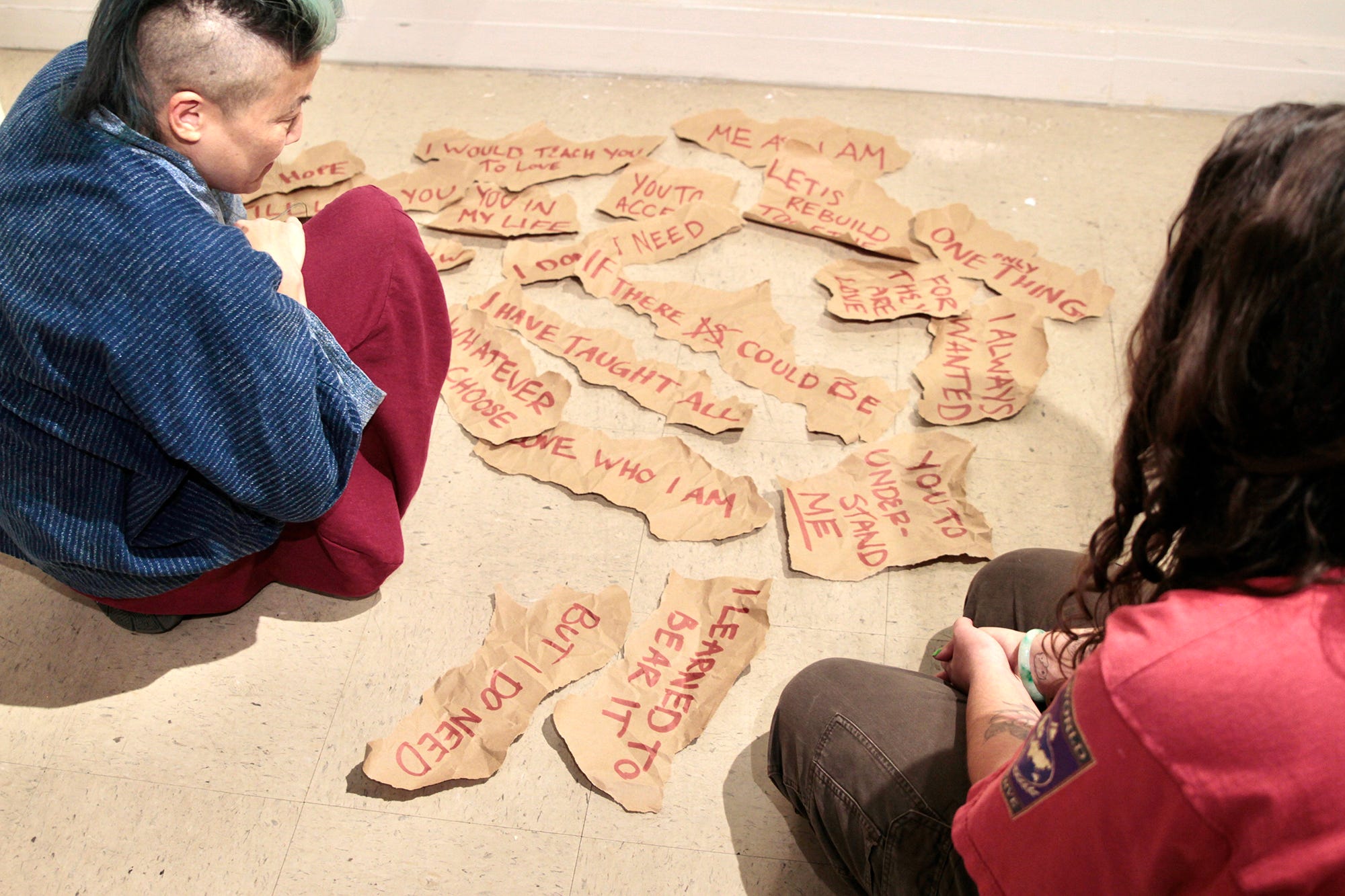
The residue of the gathering stayed in the gallery at the end of the five hours. aún sin título, 2026. Five-hour facilitated gathering and evolving installation within The sky broke when I was allowed to fly. / Se rompió el cielo cuando me dejaron volar., LA Artcore, Los Angeles. Photo by Nicole Rademacher.
In a therapy setting, the container is already built. In a public setting, someone has to build one. And once we know what an encounter can activate, we cannot design as if we do not know.
Themes like memory, displacement, adoption, and cultural rupture are deeply personal territory. How do you navigate making artwork, as you did in your recent exhibition The sky broke when I was allowed to fly., from that material in a way that feels honest without becoming extractive of your own or others’ experiences?
I try to begin from permission and from knowing that not everything has to become visible. The work comes from personal and familial material, but that does not mean all of it is available to the artwork, or to the viewer.
And for me, honesty is not the same as confession. My confessional spaces are my friendships and relationships, my private writing, and my own therapy. The artwork has another process. I write. I make. I listen back. I wait. I cross out, erase, translate. I let things linger and allow them to form and shift before they become public.
When I went to Monterrey to meet my extended biological family for the first time, I told everyone I was making artwork; my biological father had also helped explain that to my family before I arrived. I was clear it would not function like a traditional documentary. A voice, memory, or story might be present without being identifiable or directly readable.
For example, my first interview with one of my brothers, before the first trip to Monterrey, was long and open. When I listened back, my grandparents’ demolished house was what stayed with me, so that became the focus of the next interview. The rest of those conversations still shape the work even though they are not publicly legible. Material can remain present without being exposed.
aún sin título was a 5-hour facilitated gathering shaped by museotherapy and somatic practice. I co-facilitated it with traci kato-kiriyama. The works developed during the gathering were integrated into the exhibition, The sky broke when I was allowed to fly., through its run.
The participants made their own work in aún sin título, so I kept going back to them: what gets shown, how it is installed, how they are credited. Those were their pieces and every decision about them was still theirs. Consent was and is still ongoing. The difference between the work developed during aún sin título and the work I made in the exhibition is authorship. My family did not make artwork. They gave me time, stories, and access to a family I had never met. The material is theirs. The work is my experience of encountering it.
You talk about structuring encounters with “enough care, pacing, and consent” so the work doesn’t become extractive or performative. Can you walk through what that structuring actually entails? What does consent look like in a five-hour participatory piece?
The model I developed begins by slowing down. It asks people to notice what the body is registering before language arrives, then to think, wonder, and respond in whatever way the moment asks. For aún sin título, care and consent started before anyone entered the room, and did not stop there.
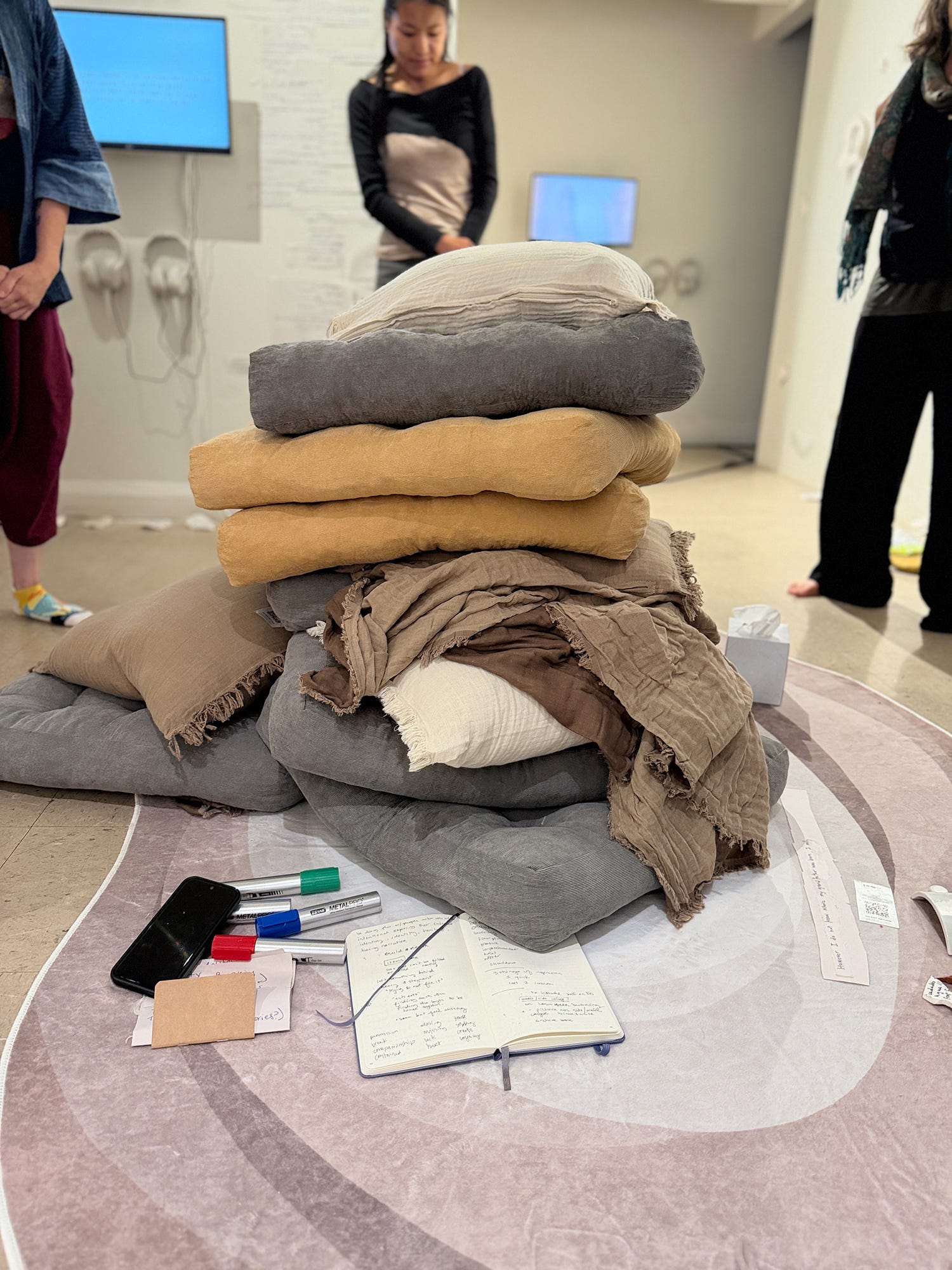
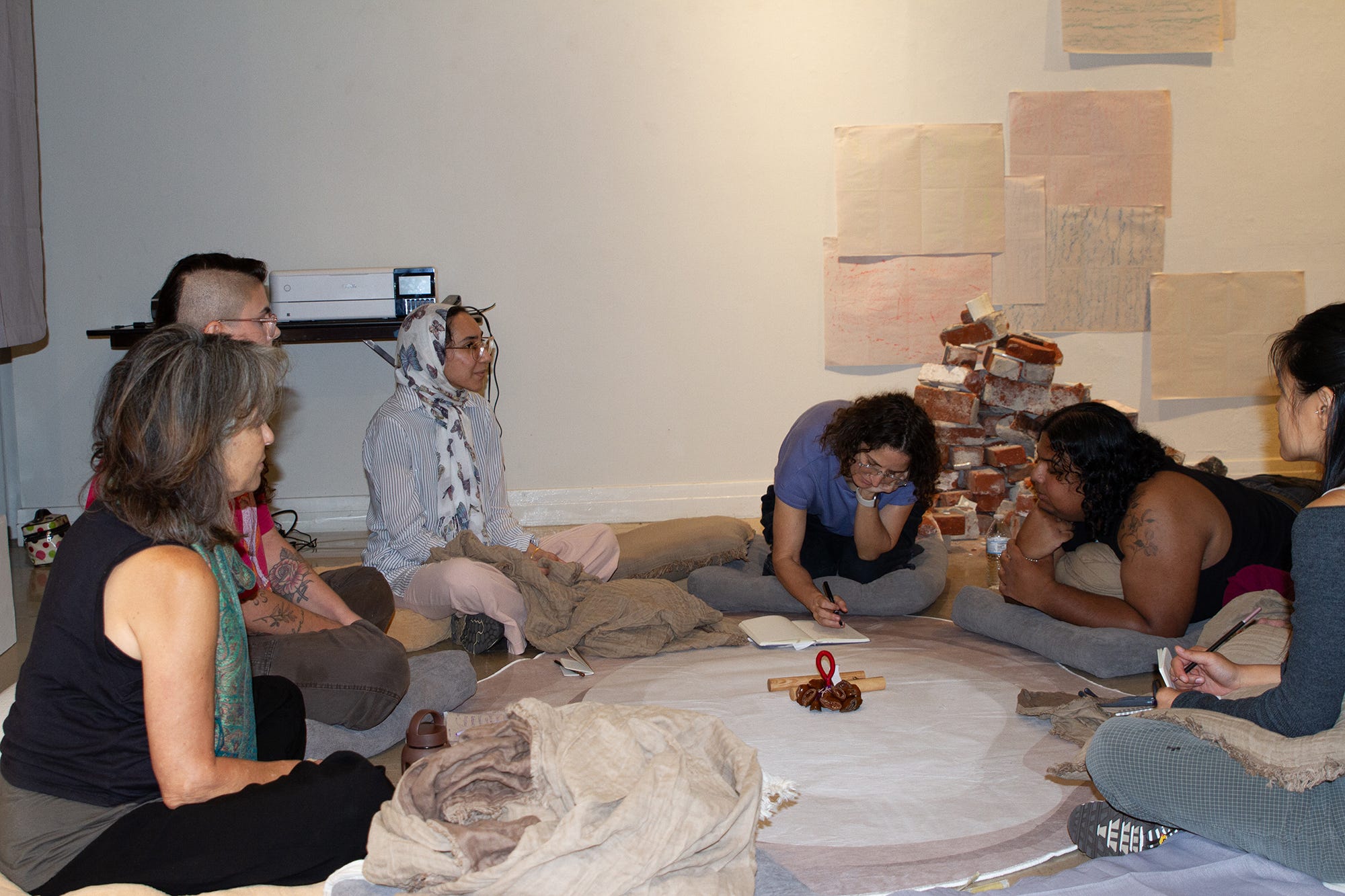
I was responsible for the initial conditions: the environment, the pacing, the invitation, and the frame. I could design for what the encounter might need, but I could not control what participants would bring, withhold, make, or change. It was a potluck. I asked people to bring something of themselves to share: something they liked, something tied to their sense of identity, something that tasted like their kitchen, or something from a restaurant they loved if they didn’t cook. Materials were plentiful and listed in advance so people could think about what they might want: 2D supplies, cyanotype paper, vellum, craft paper rolls, clay, two flatbed scanners, a printer, audio recording equipment, a ring light, and a pico projector. During the gathering, I made rest and de-stimulation materially available through low seating, an area rug, cushions and throws, a weighted blanket, an eye mask, and a place to withdraw. Rest needed to be as legible an option as making.
Participants seated on and around the rug during aún sin título. Photo by Pranay Reddy. Courtesy of Nicole Rademacher.
The application process was not a clinical screening, but it borrowed from informed-consent practices. The form named that the gathering would engage cultural loss, displacement, identity, and potentially activating material. It also asked about readiness, questions, access needs, existing support, and an emergency contact. A clinical intake asks those questions to determine whether someone is right for the treatment; I was asking what was already in place around them, because the gathering would end and was not ongoing care. I wanted people to arrive informed, and I wanted to know what the room might need.
Consent was not one checkbox. It was layered and ongoing. Participation, documentation, whether someone’s work could enter the exhibition, how they wanted to be credited, and acknowledgment that the gathering was not a replacement for therapy were separate decisions. People could ask questions before committing, opt out of documentation, and decide later whether their work entered the exhibition.
That consent continued after the five hours ended. I stayed in communication with participants about what they wanted shown, how they wanted it installed, and how they wanted to be credited. When work was installed, I sent photographs and invited notes.
Inside the room, everything was optional. People could participate, pause, rest, leave, not share, not enter a space, make something, not make something, or simply sit with what was happening. I said repeatedly that there were no supposed-to’s. Feeling something was welcome. Feeling nothing was welcome. Feeling everything was welcome.
I did not make my own work during the gathering. For aún sin título, I was tracking the room and staying available. When one participant wanted to offer an invitation to the group, we clarified the structure together and presented it as optional. It changed the sequence, because the structure had enough form to hold people and enough openness for a participant to shift what happened.
Consent also meant respecting refusal and rest. One participant had a strong response to a piece before the gathering began and later chose not to enter that installation space during an exercise. They still participated from outside it. Later, they fell asleep on the rug and cushions. I did not treat their rest as disengagement or failed participation.
It is important to me to avoid forced vulnerability. For aún sin título, I did not want people performing openness, trauma, cultural loss, or emotional availability for the exhibition. The structure had to make room for response without demanding disclosure. That is what care, pacing, and consent looked like in practice: not controlling the experience, but making sure people were not abandoned inside it.
aún sin título blurs the line between public program and artwork. Why was it important that this be a work within the exhibition rather than a program attached to it, and what changes when you make that distinction?
My exhibition in May 2026, The sky broke when I was allowed to fly. / Se rompió el cielo cuando me dejaron volar., was the first time my work as an artist, clinician, and museum-based facilitator operated as one body of work. aún sin título was not a public program attached to the exhibition. It was a work within it. Participants moved through deep looking, somatic awareness, and creative response, and what they brought into the room entered the installation and changed it.
I am still working against the word “workshop,” even though I sometimes use it because institutions understand it. My objection is not that workshops are lesser. It is that the word can carry expectations of instruction, production, critique, or a shared movement toward making something better. A form keeps carrying its expectations even when we say we are doing something else. aún sin título was not organized around any of those goals. There was no skill to master, no object to improve, and no requirement that participation produce anything. Rest, refusal, silence, incompletion, and not-making were legitimate forms of participation.
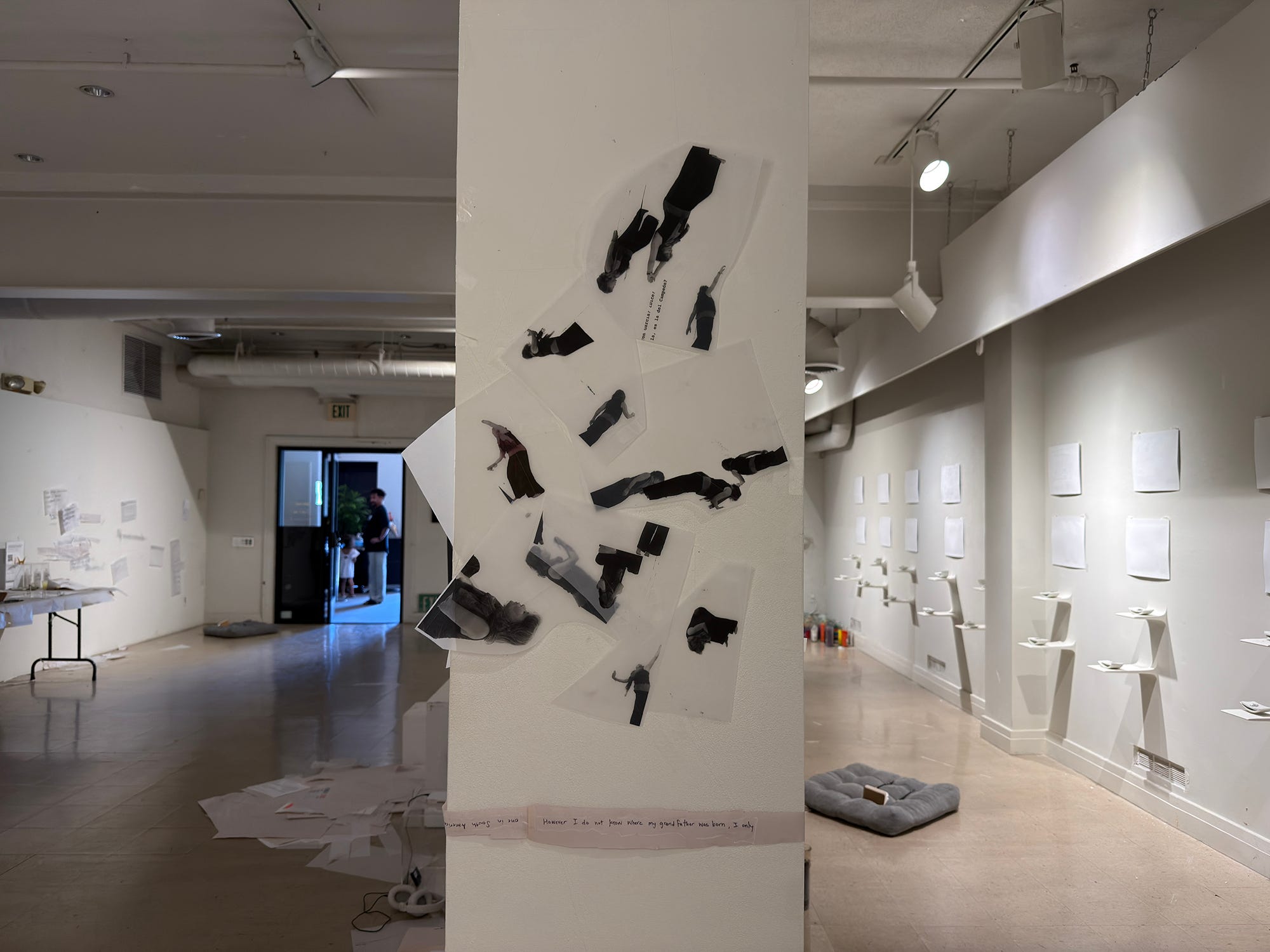
Feeling very activated by the exhibit, Diane chose to tend to the somatic response she was having. In doing so, as a way of grounding herself, she used the floor and the wall to press against. This allowed her to invite the feelings to move her in a way that felt spontaneous and supportive. The work consists of photographs and video stills Nicole took of Diane’s somatic responses during the gathering, printed on vellum, and installed by Nicole, per Diane’s suggestion. The column was chosen because it was where she had spent most of the gathering. A photograph of the finished installation was sent to Diane for approval; she had no corrections. Photo by Nicole Rademacher.
Public programs can be experimental, responsive, and consequential. aún sin título changed the exhibition’s form, authorship, and conditions. It did not interpret the work or bring people to it. It altered what the exhibition became.
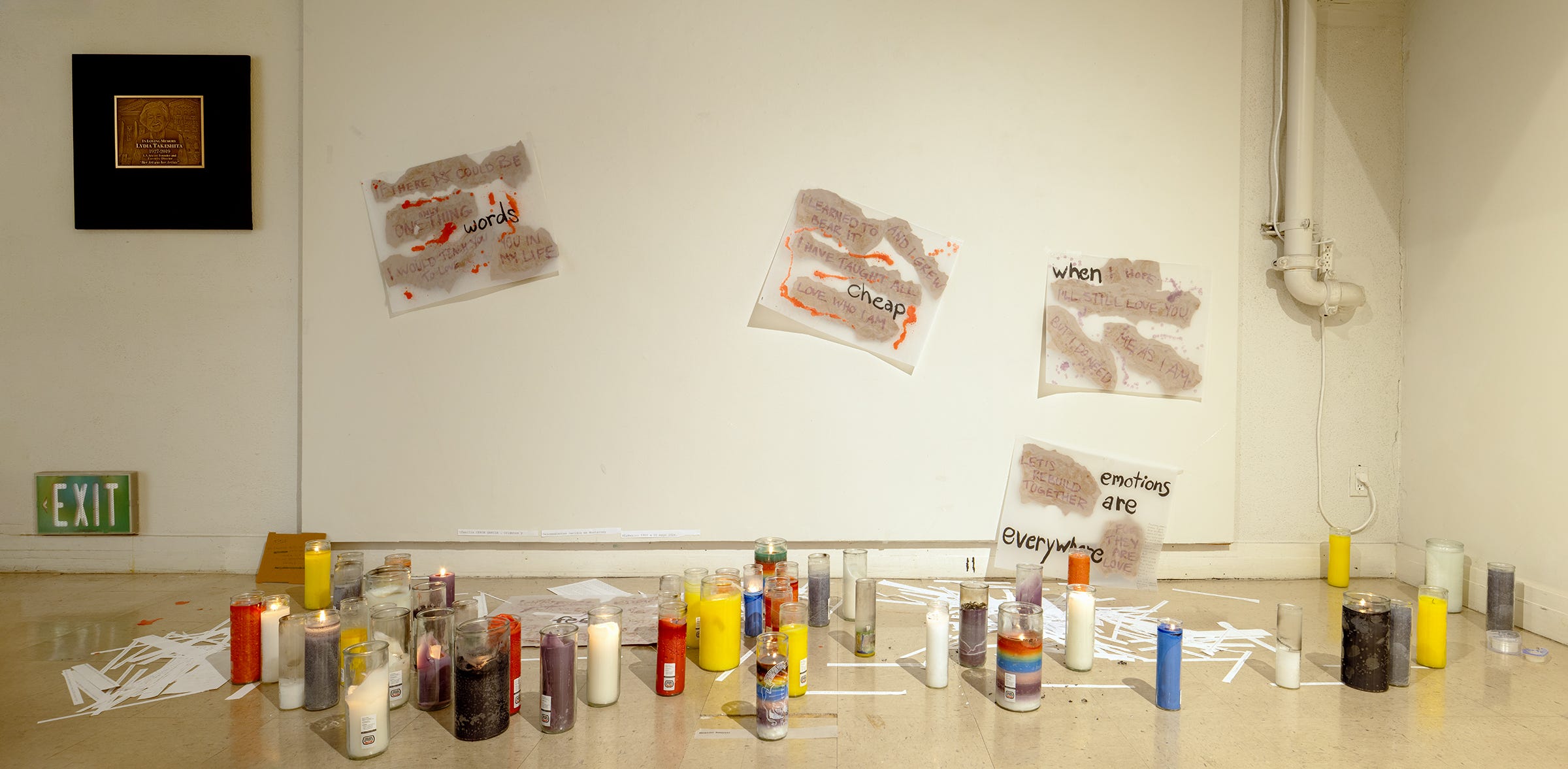
That mattered because aún sin título belonged to the exhibition’s logic. The whole show was concerned with partial access, distributed authorship, memory through others, unstable evidence, and the refusal of resolution. The gathering created a way for other people to enter those conditions through their own experiences of cultural disconnection, rupture, displacement, or not-knowing. Their responses were not illustrations of the show. One participant re-ordered fragments of letters they had written coming out to their homophobic father, mounted them on the wall, and let them run down onto the floor into my veladoras.
A work developed during aún sin título, installed in the exhibition on the wall and running down onto the floor into Nicole's work Lo que queda de lo que queda. The participant left five pieces without installation instructions; Nicole installed them and sent photographs to the participant. They were unreachable for a stretch and the correction that came back was not clear enough for Nicole to act on. It was left as installed. Photo by Panic Studios LA. Courtesy of Nicole Rademacher.
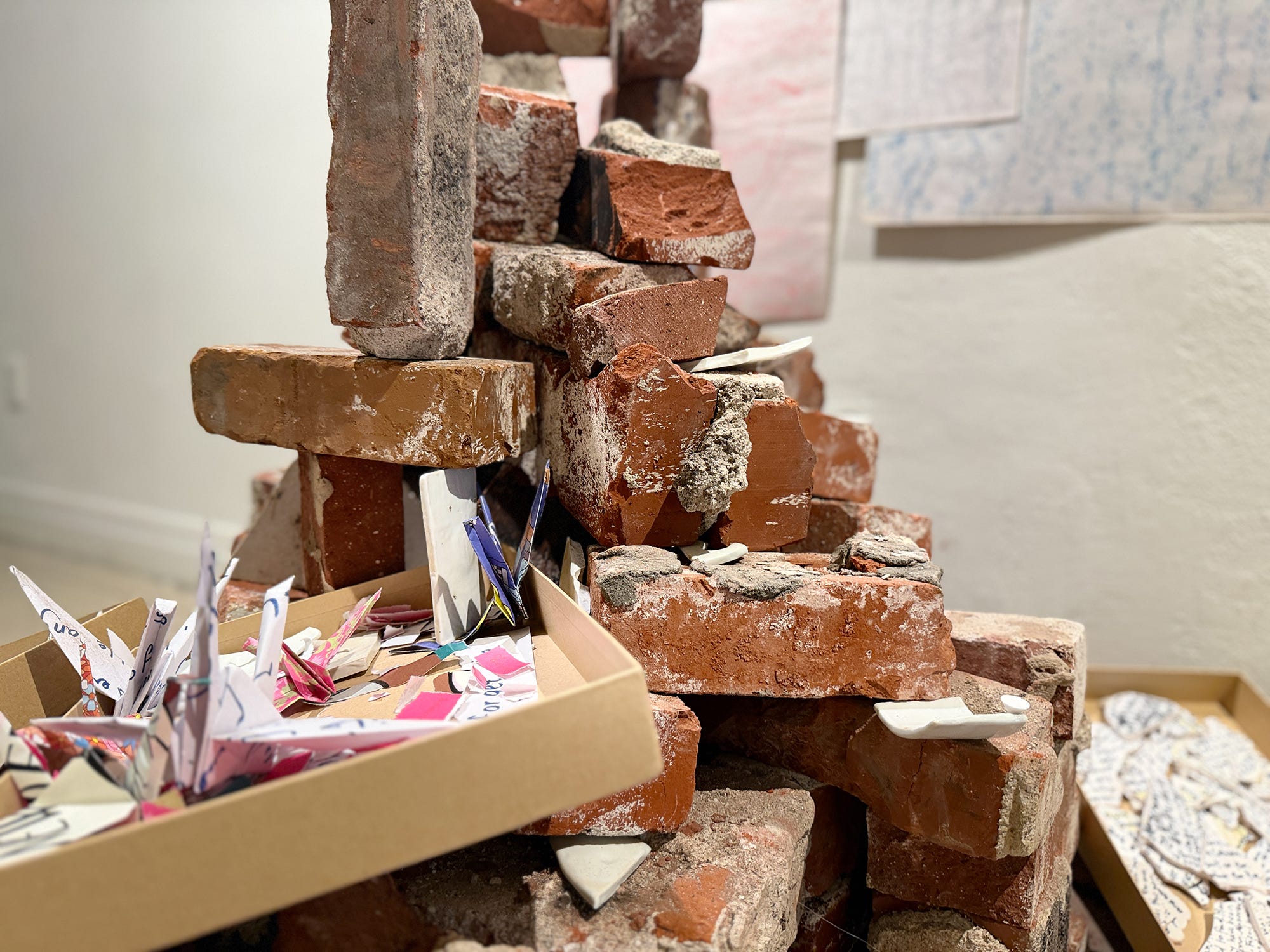
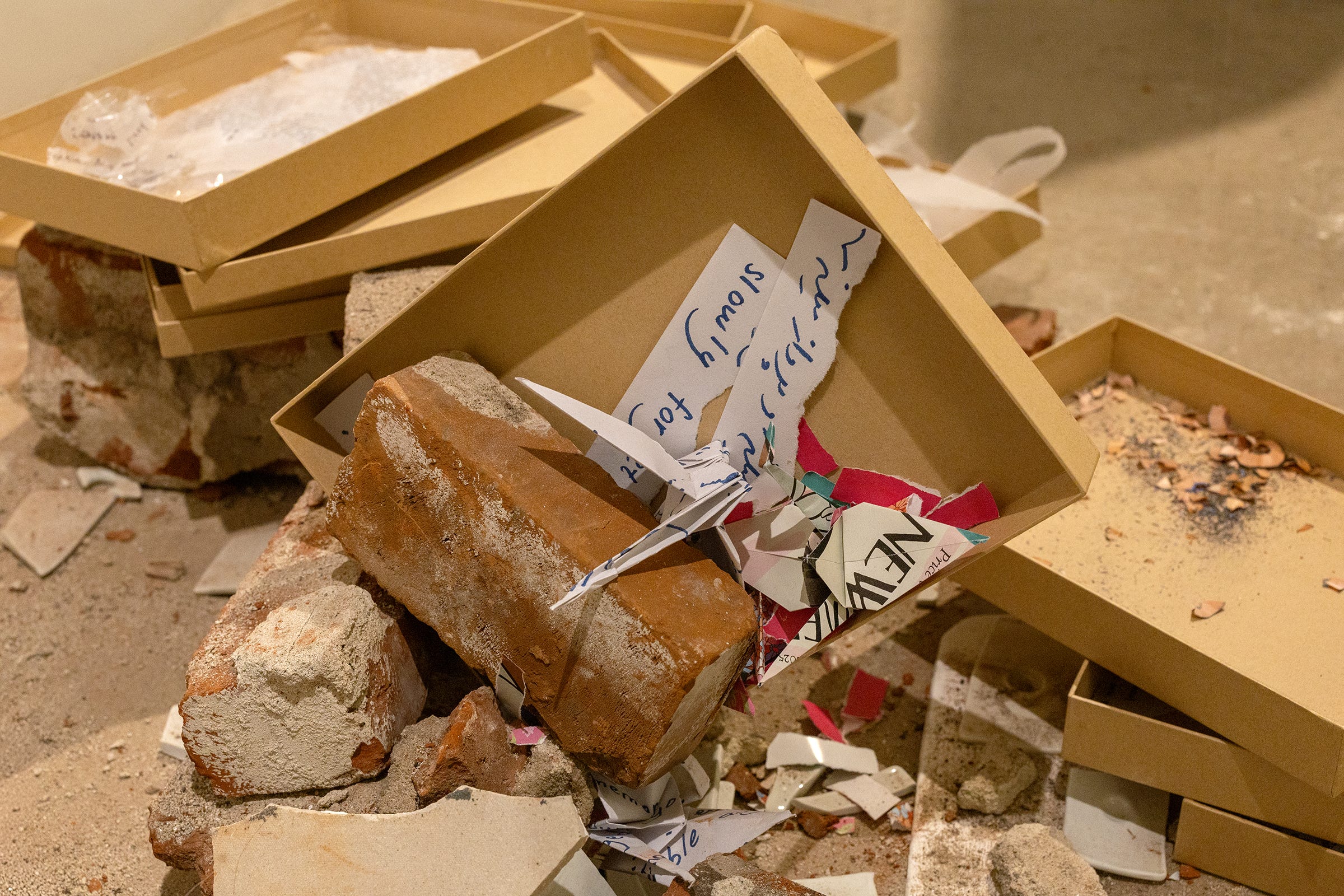
Another folded paper cranes into a kraft archive box that sat on the borrowed bricks; over the run the box tipped, and a brick came to rest inside it, on the cranes. Their work became part of the exhibition itself.
Niloofar's work, Becoming [then and now], 2026, paper art in a kraft archive box, made during the five hours and installed by her, resting on the borrowed bricks of Recurriendo a cimientos prestados. Photo by Nicole Rademacher.
Niloofar's work, Becoming [then and now], 2026, paper art in a kraft archive box, later in the run of the exhibition: the box had tipped, and a brick came to rest inside it, on the cranes. Photo by Panic Studios LA. Courtesy of Nicole Rademacher.
What changes across the frames of artwork and program is not the value of the encounter but the expectations around it: who is present, what they consented to, what happens with what gets made, who is understood to be an author. Those expectations are set by the frame, not only by the activity.
The same routing happened during the run of the exhibition. I built an activation into the work La cerámica tiene memoria: people watching a World Cup match together during gallery hours, inside the frame of the piece, with the residue of that watching staying in it: miniDV and audio documentation, residue left in archive boxes, changed seating arrangements. It was not meant to be promoted. The original idea was that the gallery and I would invite people directly. But through a miscommunication the activation ended up being announced publicly instead. It became easier to receive as an event; its tie to the work was lost. That was an ordinary institutional response to something that looked like programming. Nobody decided to reframe it. The category was already there and the work slid into it.
The exhibition was co-facilitated with traci kato-kiriyama and built for adults disconnected from cultural heritage “in all of its varied forms.” How did that collaboration shape the design, and what did “disconnection from heritage” come to mean across such a varied group of participants?
traci kato-kiriyama understood the role, boundaries, and care architecture, but chose not to pre-experience the sequence or prompts. She wanted to enter the gathering the way participants would, without knowing what was coming. I trusted that choice because I already knew how she holds space, and because her relationship to community, performance, language, and material is different from mine. She also has longstanding relationships within Little Tokyo, where LA Artcore is located. That mattered.
The collaboration changed the room because the room needed more than one way of holding. I brought somatic attention, consent, and clinical attention to pacing, response, and what the room might need. traci brought another way of opening a space, through presence, voice, and movement.
aún sin título. traci kato-kiriyama working with a participant on the gallery floor discussing their work that they were developing during the gathering. Photo by Pranay Reddy. Courtesy of Nicole Rademacher.
She entered the sequence alongside participants rather than rehearsing it in advance, so her responses emerged in relation to what was actually happening. We complemented each other because we were not doing the same thing.
The gathering was for adults disconnected from cultural heritage in varied forms, not only for adoptees. I am an adopted person, and adoptees have a specific relationship to cultural disconnection, but the room held many forms of distance: adoption and international adoption, migration and diaspora, language loss or distance, family rupture, assimilation, mixed identity, not-knowing, chosen distance, and experiences shaped by queerness or gender where inheritance, family, body, and belonging may not line up cleanly.
People could recognize one another without having the same story. Commonality did not require equivalence. Someone could hear something in another person’s experience and think, not “that’s exactly me,” but “I know something about that kind of distance.”
So yes, “cultural heritage” expanded, but it also became unstable in a useful way. It stopped being only about nationality, ethnicity, language, or tradition. It became about what is inherited, withheld, refused, chosen, lost, embodied, remembered by others, or never fully available. That instability belonged to the work. It did not need to resolve. It needed to stay open enough to hold what entered the room.
Participants’ somatic looking, writing, and object-based work were ultimately installed into the exhibition, physically shifting it. What was it like to relinquish some authorial control over the show’s final form, and how did the exhibition change once their work entered it?
Relinquishing control was part of the point of aún sin título. I built the piece so that something could happen that I could not fully predict. I let go of control, but not responsibility.
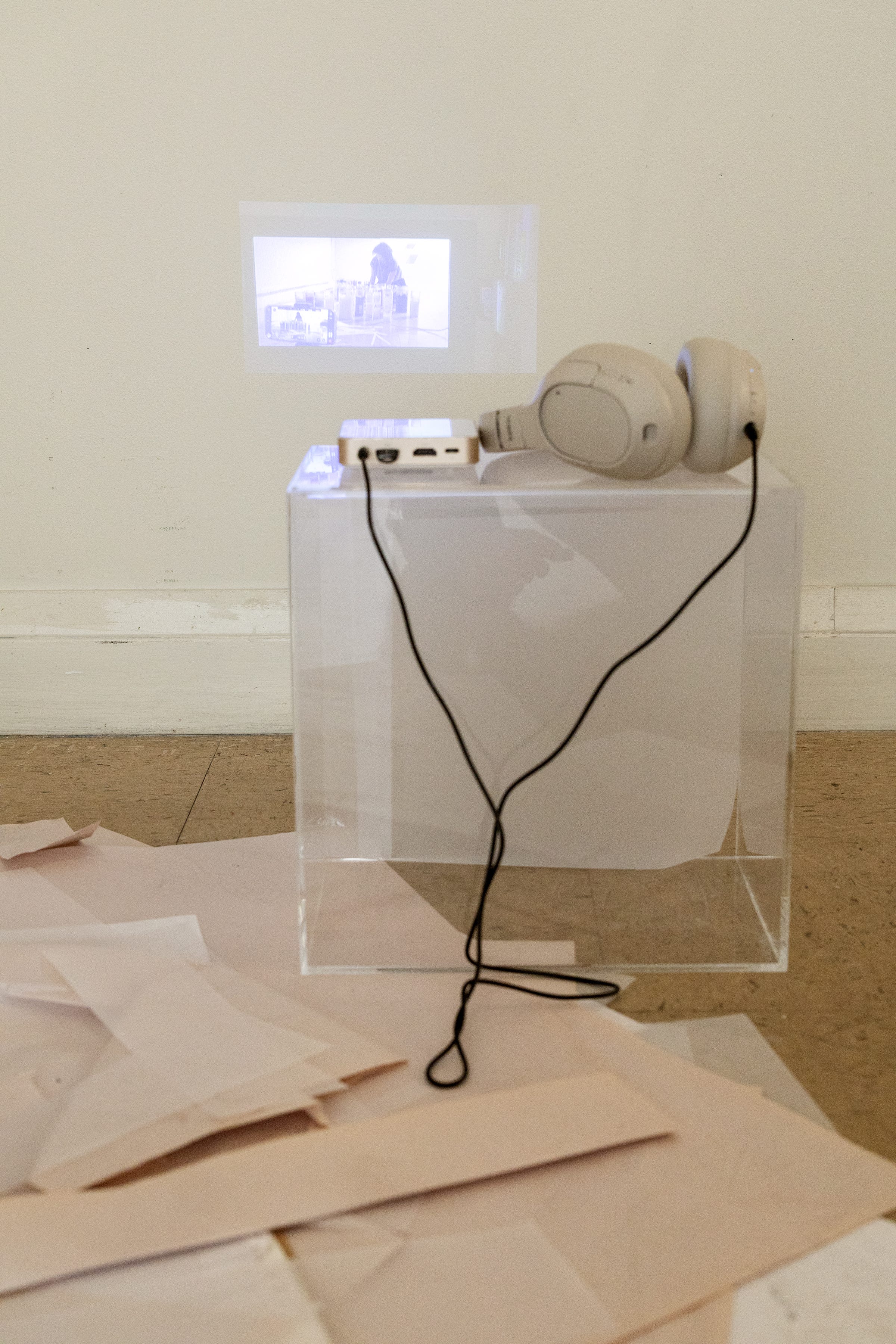
One participant used my old MiniDV camera during the five hours. When I watched what they had made, it felt like more than documentation. It was an intimate record of the time we had shared, and I knew a fixed monitor was not where it belonged.
I tested the footage with a Pico projector and headphones, sent the artist photographs of what I was considering, received their approval, and installed it that way. Viewers could pick up the projector and move through the exhibition, projecting the footage onto the floor, ceiling, walls, other works, and other bodies. The record of the gathering could move through the space instead of sitting fixed like evidence.
saki's video, shot during aún sin título using Nicole’s MiniDV camera and a professional audio recorder. The analogue footage could not be captured digitally; Nicole filmed the playback with her phone on a tripod and sent saki the captured video. saki edited from it and kept Nicole's own muttering from the head of the recording. Nicole installed, Monadic Repetition, with a pico projector and headphones. Nicole sent saki a selfie-video demonstrating the installation. saki approved the installation. aún sin título, 2026. Five-hour facilitated gathering and evolving installation within The sky broke when I was allowed to fly. / Se rompió el cielo cuando me dejaron volar., LA Artcore, Los Angeles. Photo by Panic Studios LA. Courtesy of Nicole Rademacher.
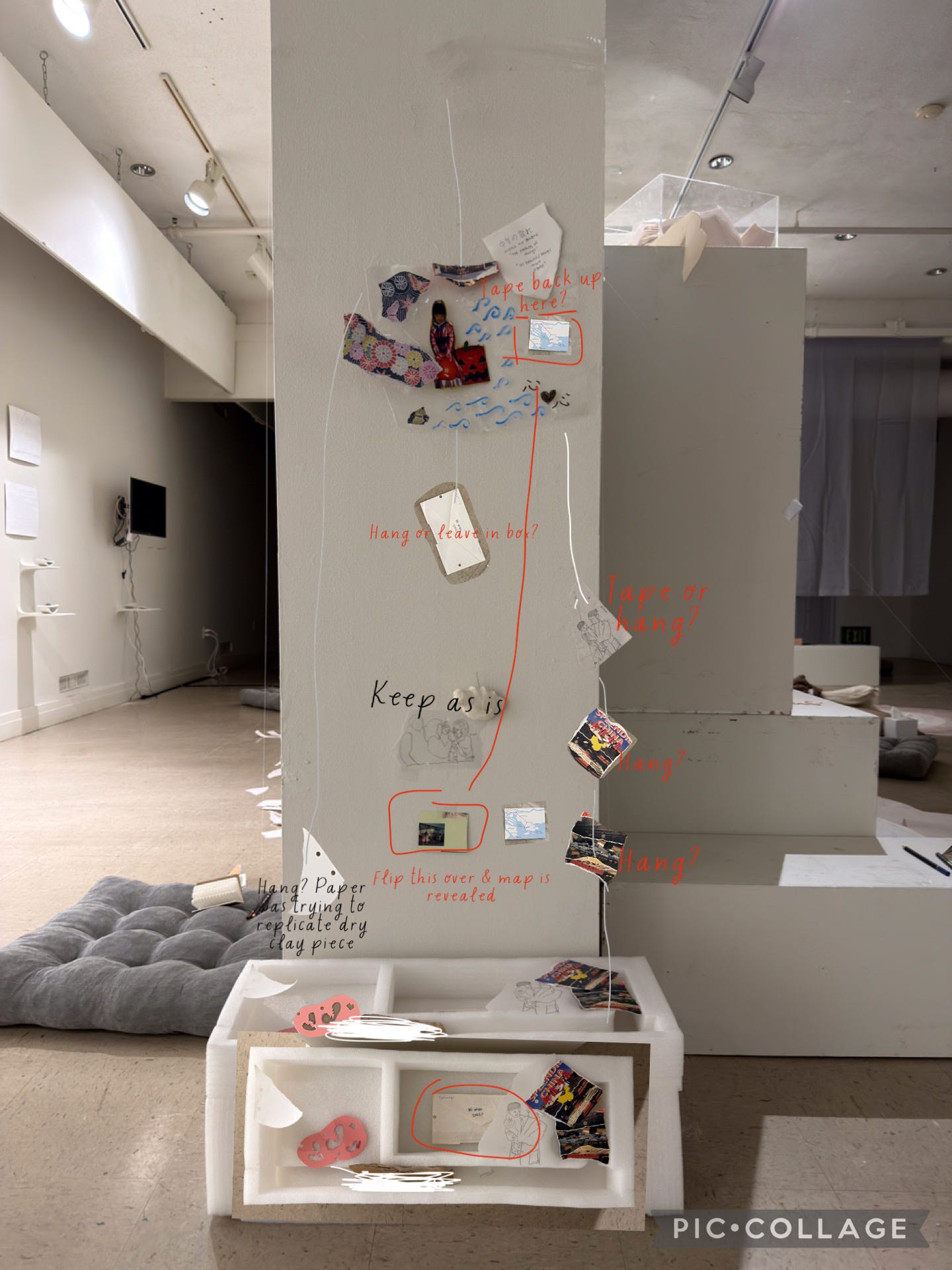
Another participant’s work needed a different process. I proposed an installation, photographed it, and sent it to them. They annotated the photograph and sent it back: tape this back up here, hang or leave in the box, tape or hang, hang, hang.
Installation instructions from Corinne for her work, traces of the unknown. Nicole installed Corinne’s work, photographed the proposed installation and sent it to her; She annotated the photograph and replied: tape this back up here, hang or leave in the box, tape or hang, hang, hang; next to one element, keep as is. The re-installation by Nicole followed her instructions. It was then approved by Corinne. Photo by Corinne.
Next to one element she had written keep as is. Next to another, a note that the paper had been trying to replicate a dry clay piece, which I had not understood and would have installed wrong. I followed their marks. The label credits the work to her, installed in collaboration with me, because that is what happened.
The exhibition was already built through the voices and memories of my family, and aún sin título extended that distributed authorship to the people who entered the room. Works that had not existed when the exhibition opened began appearing beside mine, changing the installation’s density, rhythm, and internal relationships.
The show became less like a fixed arrangement and more like something accumulating through encounter.
The exhibition also changed because the residue of the gathering stayed: the rug, floor cushions, throws, pillows, and the traces of people having been there. The space continued to hold the presence of those five hours.
People often want a finished piece. I am more interested in something being finished enough. Finished enough to hold. Finished enough to receive. Finished enough to change.
I do not know that the exhibition became less mine. I think it became more itself.
International Museotherapy Initiative is a reader-supported publication. To receive new posts and support our work, consider becoming a free or paid subscriber.