


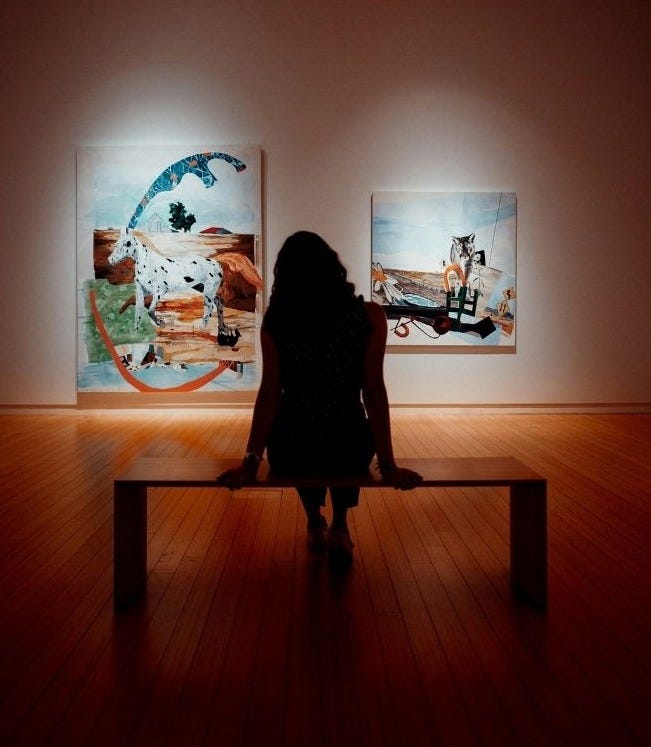
Meet any art therapist and most will tell you that art therapists belong everywhere; Our work is an integral mental health profession, and we have something to offer every type of environment. In more recent years, this discussion has continued, and art therapists are making the case for bringing their work into museums citing the therapeutic factors of museum spaces (Silverman, 2009). Other example programs that have been successful contribute to this desire to bring art therapy into the museum space (Daugherty, 2022). On the surface, museum spaces seem ripe for meeting community needs, but what about the needs of the art therapist as an employee?
Full-time work is difficult to come by in museums and is something art therapists are seeking. In my conversations at past American Art Therapy Association Conferences, in emails and phone calls, and in-person meetings, art therapists interested in museum work are seeking stability that full-time employment brings: insurance, steady paychecks, paid time off, and other benefits that can help them support themselves and their families. While I understand this desire, and it was certainly a motivating factor in me accepting my first role as a full-time museum-based art therapist, are art therapists and the way we work a good match for the museum environment full-time?
I’m going to preface this discussion by saying that I think amazing work can happen in museum spaces. They are ripe for personal reflection, and using existing works of art and artifacts as catalysts for personal growth- there isn’t anything better in my opinion. The discussion that comes next is more of a musing on some of the things I was not expecting that I, and others, have encountered when working in museums. This discussion is not one in literature that has been researched heavily, but rather a collection of thoughts I have absorbed over the years from colleagues. It is my hope to do additional formal research in the coming months on the experience of the art therapist in the museum, but for now, these composed thoughts will hopefully begin a fruitful discussion of the ways art therapists work in museums.
Like I mentioned previously, I have had many discussions with art therapists working in museums and those who are interested in starting programs in these institutions as well as art therapists previously employed in museums. There are a few things that have come up on repeat that are worth noting: 1) a lack of understanding and support institution-wide for art therapy, 2) a general frustration regarding the impact donors are allowed to have on programming, and 3) the high level of burnout experienced in a very short time.
Let’s talk first about a lack of understanding and support. Many art therapists working in museums spend a lot of time educating the public and staff about the profession of art therapy and what it looks like in the museum. They share that art therapists are concerned with the meanings and connections guests or visitors make with works of art and are less interested in the artist’s intent and other scholarly information often presented on wall labels or in exhibition catalogues. As you can imagine, this is difficult for some individuals in the museum environment to grasp and support, as their work places emphasis on the exact opposite- those scholarly facts about the artist, the movement they were a part of, and materials used are of the utmost importance. In addition to this tension that arises, many art therapy programs are championed by one person. It might be a museum director, a curator, a director of education, or someone in charge of public programming, but this one person is often responsible for the existence of art therapy programming in their institution. Museums often have high turnover rates for staff, and when that champion leaves, art therapy programs often suffer, or at the very least are changed in drastic ways. This can leave art therapists feeling frustrated at all the work they did to become an integral part of the museum staff and have their programming supported by the museum and the community, just to have it disappear or change significantly when their art therapy champion leaves.
How programs are funded is another concern amongst art therapists in museums. Most museums are funded in some capacity by donors. Some donors gift works of art while others provide financial support for the institution. In some instances, the funds provided by donors come with stipulations that impact the type of programming that can occur, the number of individuals served by the programming, or the artwork utilized during programming. This is especially problematic for art therapy programming in museums. Let’s go back for a moment to my time in graduate school. I was taught that everything we do is in service to our clients. According to the Art Therapy Credentials Board (n.d.), “Art therapists shall provide services which are in the best interest of the client and shall make their best efforts to support each client’s rights and maximize the therapeutic benefit for each client.” You’re thinking about self-disclosing- is that for you or for the client? If it’s for you, put that comment to the side; it’s not the right time to share. You feel like painting today- is that your need or the client’s need? If it’s your need, put the paint back and grab colored pencils, because that what your client needs. Art therapists do our best to put clients first, not our own agenda, and we would prefer not to place institutional needs above the needs of our clients. When donors are involved and have significant say in the types of programming provided in museums, art therapists as a part of this system are unable to put community needs first. There is some of this that exists in almost every job an art therapist has- it is not isolated to museums. Any job where an art therapist works with insurance companies is somewhat beholden to what they deem appropriate for clients; the number of sessions allowed or specific services provided or covered are dictated by the insurance companies, not the clinician providing the services and seeing firsthand the real needs of the client. So why would institution first or donor first allegiance be problematic in the museum setting if this type of thing happens everywhere art therapists work? In my experience speaking with other art therapists, employment at a museum is seen as a way to get out of the “system.” They believe they will be in full control of programming, without having the same restrictions placed on them like in community mental health centers when dealing with insurance companies. This can leave the art therapist feeling like the job they took at the museum is not what they thought it would be leading to frustration.
Combine these two points above with difficulty maintaining boundaries and you have a recipe for burnout. There is a sense of urgency always present in the museum environment. Emails that come through need answered yesterday, and there is almost always a more urgent need than what just came through not 2 minutes prior. Everything feels rushed, which was always a bit strange to me considering exhibitions are planned years in advance. When talking with other museum-based art therapists, there almost always is a connection made between the push for increases in programming, both the numbers of programs and the number of people attending those programs, and the lack of adequate staff to create and manage these programs that creates this sense of urgency. If museums don’t have enough new staff to cover increases in programming, this causes current staff to spend more and more time leading and creating programming, leaving the other administrative tasks they complete to be placed on the back burner. These tasks pushed aside are often completed at the absolute last second possible, thus enters the sense of urgency. Most clinicians are told to leave work at work as much as possible; complete your notes before leaving for the night and be sure to take a minute to decompress before tending to other roles in your life like being a spouse or a parent. This is almost impossible in the museum environment. Most art therapists I talk to that work full-time, and even part-time in the museum have the feeling of being on call. Emails are expected to be answered in the evening or on vacation if it’s urgent. This way of working contrasts with the things we often teach our clients about work life balance and leads to a blurring of boundaries and for a job to take the number one place in someone’s life.
Now, shall we attempt to answer the question I posed earlier? Are art therapists a good fit for the museum environment full time? The truth is, it depends on the priorities of the individual, but I do think we need to think hard before we push art therapists to be in every museum in the country. What I am going to propose is a different way of approaching the intersection of art therapy and museums. What if we push for art therapists as independent contractors? This allows the art therapist to have the most control over the type of programming they offer, all while avoiding some of the challenges of being immersed in the museum environment. These art therapists could partner with other non-profit organizations like recovery centers, eating disorder clinics, day centers for adults with cognitive challenges to write grants, create programming, and propose these ideas to the museum. Yes, this way of working has its challenges, and you still need an art therapy champion within the institution, but this way of working places clients, community, and art therapists’ needs in the center, with the museum playing a supporting role.

References
Art Therapy Credentials Board. (n.d.). Code governing standards of practice, eligibility for and regulation of credentials, and disciplinary procedures. https://atcb.org/ethics-appeals-lp/code-of-ethics-conduct-and-disciplinary-procedures/
Ghadim, M. R., & Daugherty, L. (Eds.) (2022). Museum-based art therapy: A collaborative effort with access, education, and public programs. Routledge. https://doi.org/10.4324/9781003014386
Silverman, L. (2009). The social work of museums. Routledge. https://doi.org/10.4324/9780203862964
Thank you for this thoughtful piece - lots to think about here. I wanted to share a positive example that might be of interest: the National Gallery of Ireland's No Words programme, built collaboratively with an art therapist and a domestic violence service, independently evaluated, and by 2025 leading to the appointment of their first resident Cultural Art Therapist. You can find out more about the programme here: https://www.nationalgallery.ie/what-we-do/education-department/community-engagement/no-words-cultural-art-therapy-community And I spoke with Sinéad Rice, Head of Education and Public Programming, about this work recently on my podcast too, as part of an episode reporting from a European conference on museums and wellbeing: https://podcast.artengager.com/episode/who-cares-museums-wellbeing-and-resilience/