

An interview with Dr. Hana Joo, art therapist and designer whose doctoral research developed a model for museum-based social prescribing in Korea.
Corrections to this article were made on September 24, 2026 by Brooke Christensen: The name of the museum in the title was corrected to the full name of Suwon Museum of Art, and in the korean context, two phrases were removed.
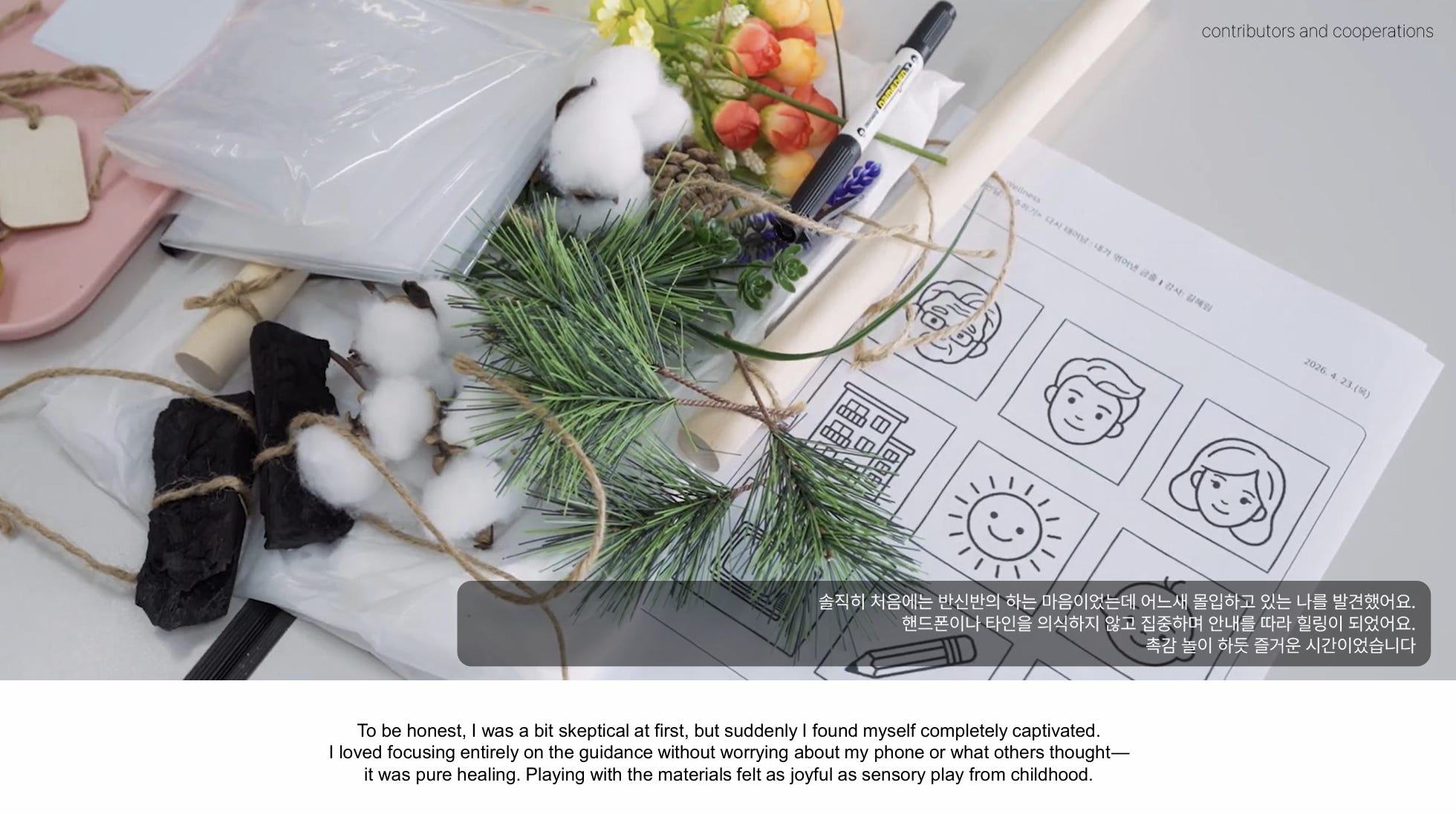
Art in this article provided by Dr. Hana Joo
Follow Dr. Hana Joo’s work here
This interview is part of an ongoing series exploring how art therapy lives beyond the clinic, such as inside museums, public institutions, and shared cultural spaces. One of the goals of this series is to center international voices, particularly since many international museotherapy and museum-based art therapy programs are more established than they currently are in the United States.
For this conversation, I spoke with Hana Joo, an art therapist and designer based in Seoul. She teaches graduate art therapy at Hongik University and service design at Seoul Women’s University, and her doctoral research built an operational model for museum-based social prescribing, tested through two empirical studies and refined through a Delphi panel of art therapists, curators, service designers, and health and welfare administrators. That framework now runs as an ongoing collaboration between Hongik University, the city of Suwon, and the Suwon Museum of Art.
A brief note on language: Hana responded to these questions in Korean, and both Korean and English versions are published here so the interview is accessible to readers in both languages. Genertative AI via Anthropic’s Opus model was used for translation. Please consider supporting us, so in the future we can hire humans to provide translation for our international interviews.
What follows is a conversation about designing care into public space. About cortisol tests that contradicted the questionnaires. About figures who started out small and expressionless and ended up dancing in the rain. And about what a trained art therapist adds to a room that a museum educator already knows how to hold. Please enjoy this written interview!
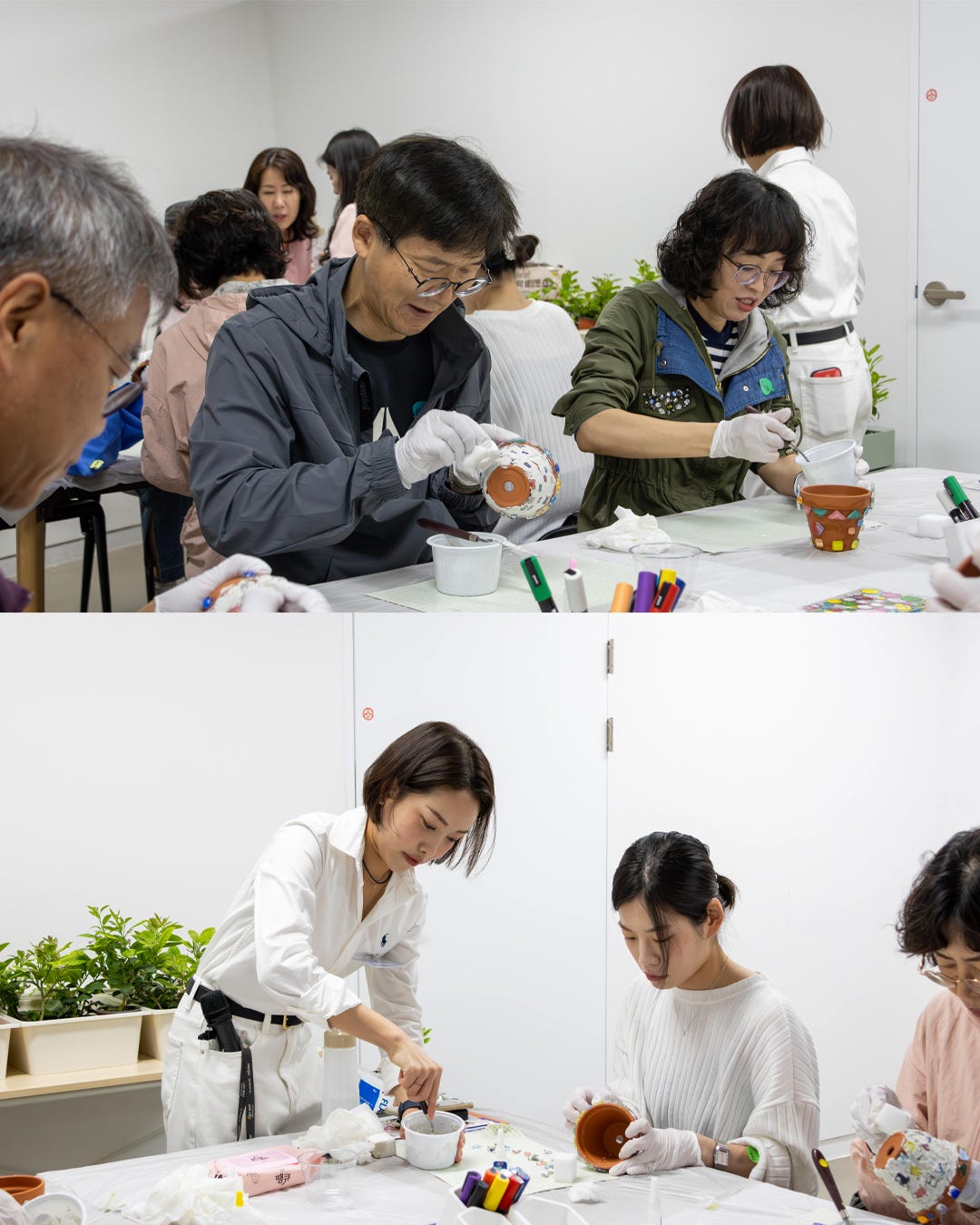
Brooke Christensen: After majoring in art therapy, you pursued a Ph.D. in Design at Hongik University. This is not a typical path. What motivated you to frame this research through the lens of ‘design’?
Hana Joo: While studying design as an undergraduate at Hongik University, I learned to analyze and understand user experience, which naturally led me to question how we can truly understand and support people’s minds and behaviors within their social environment. This reflection guided my journey toward becoming an art therapist working with clients’ inner worlds, diving deep into human psychology and healing through expressive arts.
Working as both a designer and an art therapist sparked an integrative research question: “Can we build an inclusive, diversity-respecting, and safe therapeutic holding environment outside the closed space of a traditional therapy room?” To me, design and art therapy have never been separate or distinct domains.
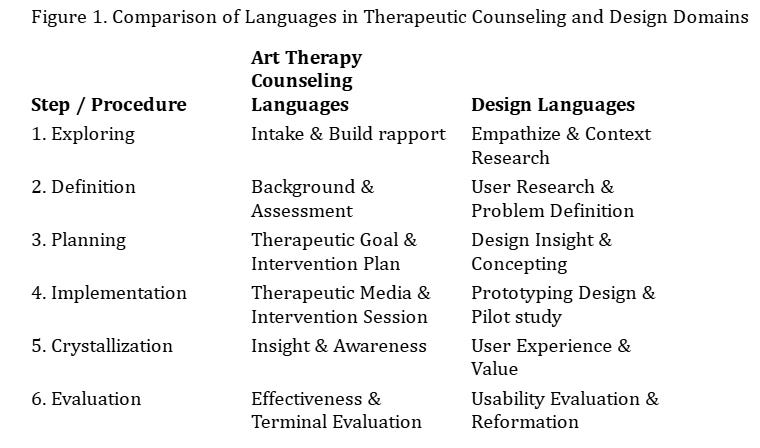
As illustrated in Figure 1, the dynamics of art therapy—moving from rapport building (exploration) to problem definition, therapeutic intervention and media application (implementation), and insight and sublimation (meaning integration)—align 1:1 with the design process. Ultimately, if art therapy facilitates microscopic healing on an individual level, design serves as a vital language and framework that expands that therapeutic process into the public realm.
To put it another way, if an art therapist acts as a Therapeutic Container holding a client’s emotions within a session, design provides a Holistic Frame—encompassing space, media, movement pathways, roles, relationships, community engagement, and policy—enabling that healing experience to take place safely in public environments like museums and local communities.
Christensen: Was there a specific moment or experience with participants that convinced you this work could function as a public service rather than a one-off program?
Joo: The seed of this idea began in 2010 at the Queens Museum in New York, while co-planning and facilitating a museum art therapy program for children with developmental disabilities and their families alongside my supervisor, Michelle, and my colleague, Mitra. Watching children and parents step outside traditional clinical spaces into an open museum environment, feeling psychological safety and connecting through expressive media, revealed the latent potential of museums as healing spaces.
This conviction grew even stronger in 2015 during the Share & Empathy project at the National Museum of Modern and Contemporary Art (MMCA) in Korea, designed for seniors with dementia, their families, and caregivers. What I witnessed on-site was that healing resided not merely in the artwork or media themselves, but in the relational healing born of genuine human connection.
“It is my first time visiting a museum, and it feels truly heartwarming to be welcomed like this and to express my story through art.” — Participating Senior
“I always lived in constant tension due to changes in my mother’s behavior. But seeing her smile brightly while looking at artwork and creating things together in the museum helped me lay down my emotional burden and find comfort.” — Family Member / Caregiver
In a museum environment where cultural dignity is preserved for everyone, participants were transformed from ‘patients’ into ‘active agents who enjoy and create art’. This made it clear that emotional connection and healing through art must take the form of a structured public service so that it can serve as a continuous safety net in participants’ daily lives rather than ending as a single-event program.
Christensen: Social prescribing has been discussed for a long time in the UK and Canada, but was introduced relatively recently in Korea. Beyond mere translation, what kind of conceptual ‘translation’ was necessary for this concept to be understood within the Korean institutional context?
Joo: To adapt NHS-based social prescribing from the UK to Korea, we needed to reinterpret the concept of a ‘clinical prescription’ into ‘community-based connection and everyday care intervention’.
As art therapists in the US and UK know well, the word ‘prescription’—rooted in a medical model—can inadvertently make the general public feel burdened by illness or treatment, invoking social stigma. In Korean society, while psychological barriers to visiting hospitals or counseling centers for mental health have lowered over time, they remain significant.
Therefore, rather than framing social prescribing as a ‘medical directive issued by a physician,’ we translated it into Community Art Therapy—an effort to foster emotional well-being using art therapy techniques and media in the welcoming, aesthetic environment of a museum.
By fostering collaboration between public health/welfare centers and public art museums, clients previously confined to clinical spaces were gently guided into cultural and artistic healing. Restoring therapeutic agency to both clients and the local community through this structural shift was the crucial key to convincing Korean institutions and the public.
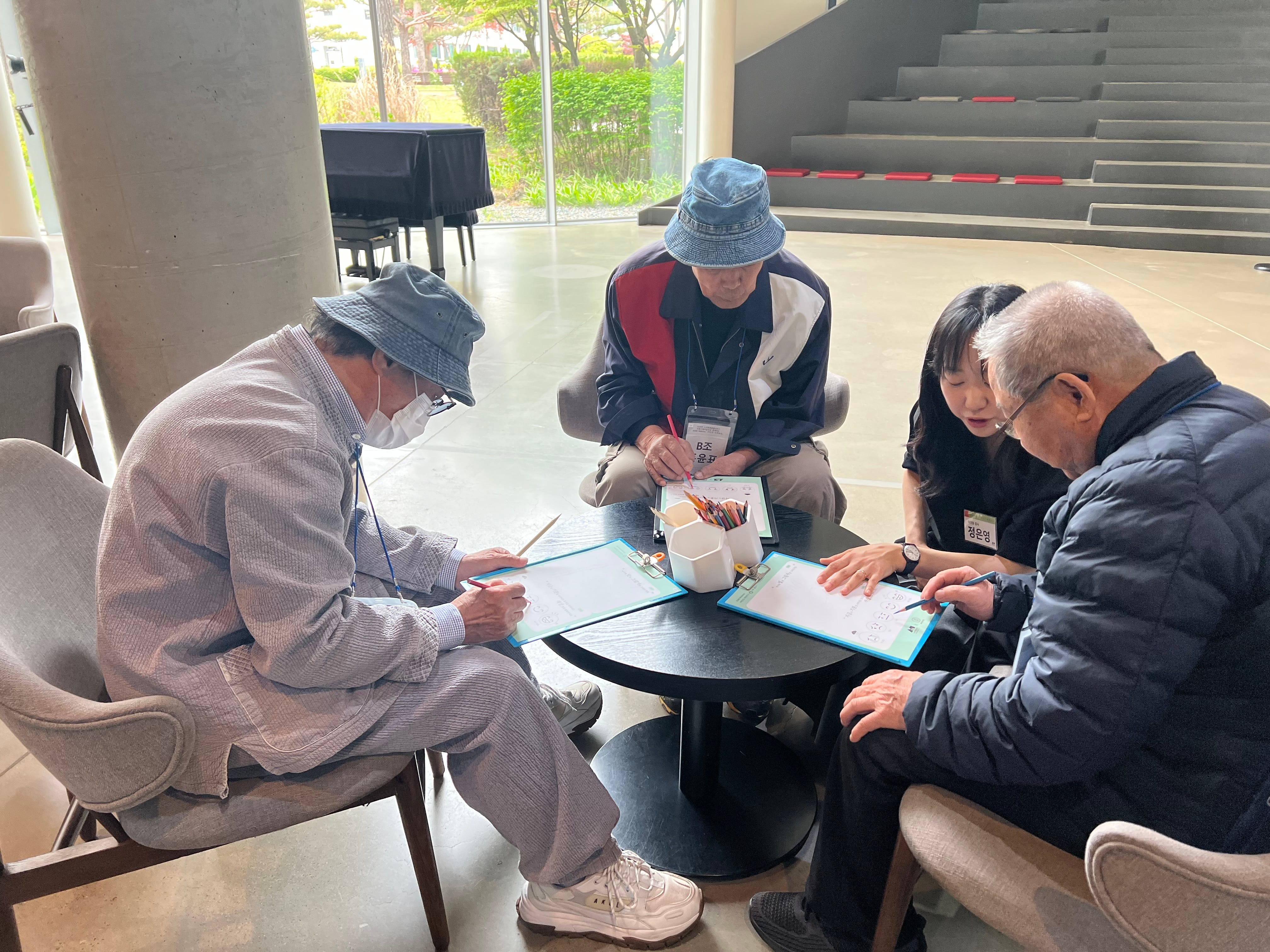
Christensen: Prior research shows that more than half of existing social prescribing studies focused on older adults aged 65 and above. You intentionally focused on young adults; why did you feel this shift was urgent?
Joo: As an art therapist, my focus on young adults came from realizing that despite experiencing deep psychological isolation and emotional distress, this group exhibits the highest levels of ‘therapeutic resistance’ and ‘fear of peer stigma’.
While most health and welfare resources in an aging society target the elderly population, young adults suffering from isolation, depression, and suicide risk have been overlooked in a blind spot of care. Young adulthood involves the vital developmental task of building self-identity and social relationships, yet many lack opportunities to build Emotional Literacy—the ability to recognize and regulate their emotions amid high competition and isolation.
Furthermore, because young adults are key to sustaining a healthy society in the future, preventive education is essential to help them care for themselves before reaching a crisis point. I concluded that ‘preventive therapeutic intervention’ prior to clinical visits was urgent. Providing a sensory, non-threatening space like a museum where young adults can safely express their inner selves and regulate emotions through non-verbal, symbolic media is the most timely and effective art therapy approach to this crisis.
Christensen: You measured salivary cortisol alongside psychological scales and projective drawing tests. What evidence did physiological indicators provide that self-reported scales alone could not capture?
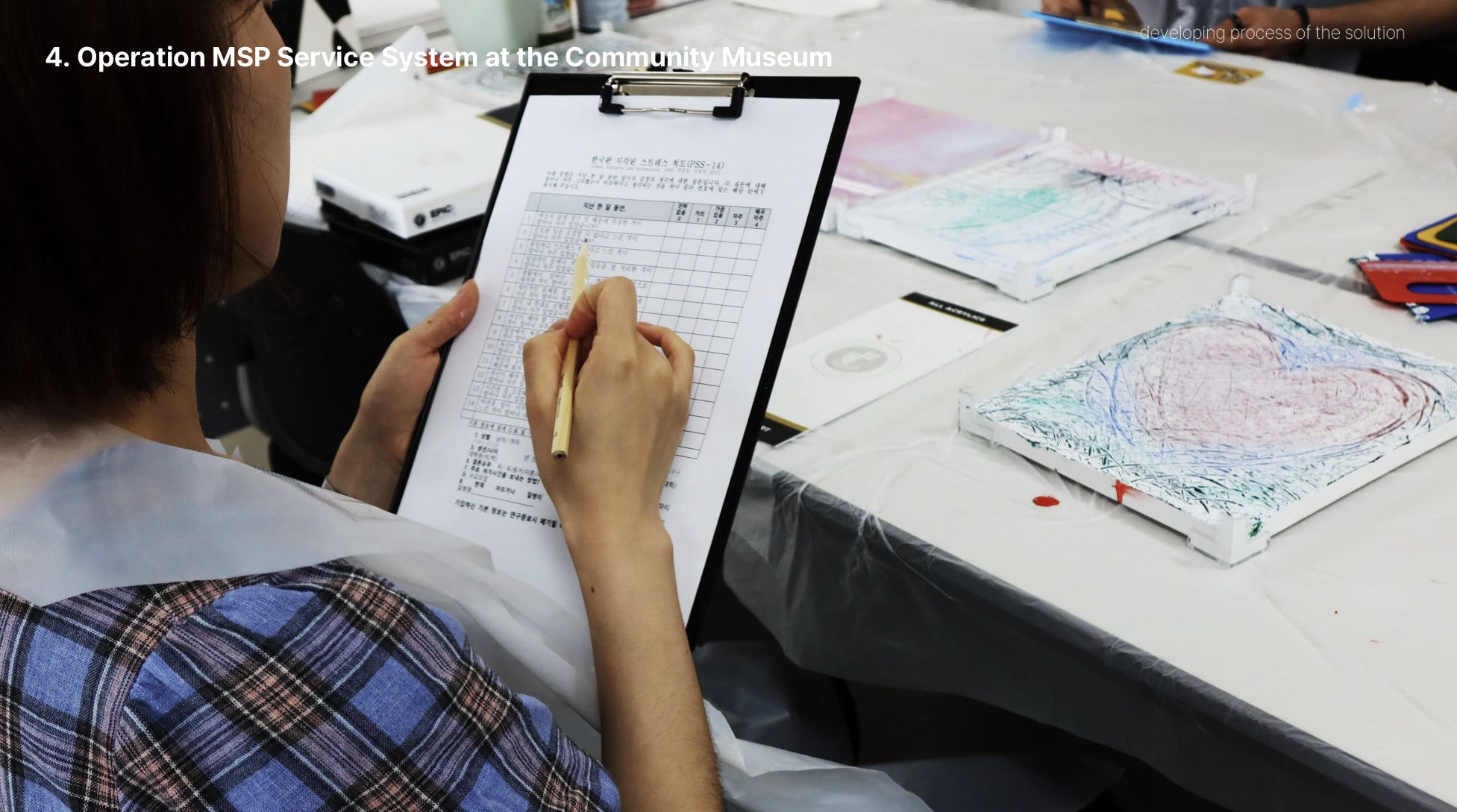
Joo: Combining physiological indicators (salivary cortisol), self-report psychological scales, and projective drawing tests (such as PPAT/DAPR) allowed me, as both a researcher and clinician, to achieve objective results through data triangulation. Physiological indicators helped overcome the inherent limitations and social desirability bias of self-report surveys.
In Korean culture, participants often tend to offer positive responses to evaluators or researchers. For instance, one participant reported a significant reduction in stress on the post-test Perceived Stress Scale (PSS). However, their salivary cortisol levels actually increased, and their projective drawings showed emotional contraction—such as diminished coping resources or omitted facial features. Without cross-validating projective and physiological data, we might have mistakenly categorized this intervention as ‘effective’. This multi-angled analysis allowed us to place the participant in a ‘group with minimal short-term intervention effect’ and adjust future intervention strategies accordingly.
Additionally, physiological metrics prevented us from unilaterally misinterpreting cortisol elevation as purely ‘increased stress’. Cross-referencing the data with time-matched baseline cortisol values for Korean adults revealed that cortisol elevation within a normal range actually signified positive life arousal rather than distress.
This physiological activation aligned with drawing test results, where facial expressions became richer and relational elements with the environment and others expanded. Physiological indicators thus provided solid evidence of how art therapy interventions impact a client’s mind-body system, showing that multi-faceted measurement is essential for accurate analysis.
Christensen: What was the most unexpected finding in your research? Were there any outcomes that differed from your initial expectations?
Joo: My doctoral research involved two empirical studies: a primary pilot study (30 university students, 3 hours at an art center) and a secondary operational study (62 adults, 5 sessions at 2 hours each in collaboration with a museum). Going into the research, I anticipated that most participants would show stress reduction after the program, but the empirical results told a different story.
The most striking discovery across both studies was that participants naturally divided into three distinct categories:
Everyday Prevention Group: Individuals with healthy coping skills who could immediately use the museum as a space for ongoing self-care.
Selective Intervention Group: Individuals with high baseline stress who showed remarkable therapeutic gains after intervention, including physiological relaxation and emotional relief.
Non-Responder / Non-Change Group: Individuals whose psychological and physiological changes were minimal through short-term museum interventions alone, indicating a need for custom, long-term engagement and self-understanding.
Segmenting participants using the design concept of user personas—rather than treating them as a monolithic group—enabled us to design tailored preventive counseling strategies. It reaffirmed the clinical truth that a single program cannot heal everyone, while offering clear evidence for identifying target audiences and mapping out subsequent Service Pathways—determining who can benefit from daily cultural engagement versus who requires referral to specialized health and welfare services.
Christensen: For art therapist readers, what actual changes did you observe in the participants’ drawings? Were there qualitative changes in images that numerical data could not capture?
Joo: Expressive vitality and symbolic transformation—which numbers cannot capture—are precisely what art therapists look for most. Subtle emotional dynamics uncaptured by quantitative scales are often vividly revealed on paper. In the physiologically and emotionally activated group, pre- and post-tests of the Draw-a-Person-in-the-Rain (DAPR) test showed remarkably distinct qualitative shifts:
Pre-test Drawings: Participants used only a small portion of the paper, drawing small, expressionless figures with very limited or hesitant coping resources (such as tiny umbrellas or rainboots).
Post-test Drawings: Figures proactively claimed the entire space, standing confidently in raincoats, smiling brightly, or dancing in the rain with open umbrellas. Furthermore, symbolic re-interpretations of rain emerged—such as lotus leaves, frogs, and water droplets—transforming rain from a stressful stimulus into a vibrant, living environment.
This spatial expansion and playful symbolism in drawings matched post-session behavioral observations, where participants laughed, conversed, and enjoyed community connection.
These qualitative changes served as milestones beyond simple test scores, illuminating participants’ inner desires and opening doors toward self-understanding and healthy relational awareness. Based on this analysis, we delivered personalized reports to participants and supported them in connecting with daily cultural environments and self-care groups.
Christensen: You defined museum art therapy as an intervention aimed at development and well-being, distinguishing it from symptom-alleviation-centered clinical therapy. How do you maintain this boundary in practice, especially when clinical needs arise during a session?
Joo: Having worked as an art therapist and supervisor in clinical psychiatric settings, as well as in cultural institutions like the MMCA and the Queens Museum in New York, I have come to realize that hospitals and museums are not disconnected worlds; they exist along a single continuum of healing.
When launching museum art therapy alongside researchers and students at Hongik University, a trainee once noted: “I thought museum art therapy would be easier than a hospital, but practicing it feels like a dynamic, profound field that requires a therapist equipped with comprehensive clinical and educational experience.” That observation was spot-on. Fostering development and well-being in a non-clinical space does not mean stripping away clinical depth; rather, it demands subtle boundaries anchored in deep clinical insight.
During an open-studio group session, a participant became overwhelmed with emotion while creating art and burst into tears. Silence fell over the room, and the flustered trainee looked to me for guidance. At that moment, a fellow participant warmly reached out with empathy:
“It’s okay. I cry for no reason sometimes, too.”
This illustrates the unique therapeutic strength of an open museum setting. Before a therapist steps in to control the situation with rigid clinical protocols, the sense of safety cultivated among the professional facilitator, the group, and the welcoming space naturally fosters shared empathy and community bonds.
While Korean participants can generally be cautious about exposing their vulnerabilities, the museum environment itself helps soften personal defenses. Instead of fixating on pathology or clinical interventions when unexpected situations arise, therapists act as orchestrators—shaping the boundaries of space, media, and group dynamics so that expressions are safely contained without regressing into severe distress. A therapist who respects clinical boundaries can safely hold a museum as a therapeutic space open to all.
Christensen: Museum educators are already excellent facilitators. What unique competency does a trained art therapist bring, and how do you explain this difference to museum professionals?
Joo: Today, ICOM defines museums as inclusive, diverse, and sustainable institutions. Consequently, traditional museum domains like exhibition, conservation, and education must collaborate across multidisciplinary fields to create meaningful opportunities for public participation.
Museum educators are outstanding professionals who deeply understand museum identity and the educational value of exhibitions, expertly guiding visitor engagement. What a trained art therapist adds to this environment is clinical sensitivity to read non-verbal emotional dynamics and the capability to construct a psychological safe zone.
While educators facilitate intellectual and sensory expansion through exhibition content, art therapists pick up on subtle psychological cues hidden behind shyness, silence, resistance, or emotional expression. When unconscious emotions or vulnerabilities surface through viewing or creating art, the art therapist’s expertise lies in safely reflecting these feelings while maintaining emotional stability.
When explaining this distinction to museum practitioners, I emphasize that these domains are not in conflict, but are partners along a single continuum dedicated to visitor well-being.
Art therapists are not here to replace museum education. When educators and art therapists collaborate, museums can expand beyond ‘spaces of knowledge and appreciation’ into ‘integrative healing spaces’ where emotional healing and personal growth occur hand in hand.
Christensen: Through a Delphi survey, 22 operational elements were finalized. Which element saw the greatest divergence of opinions among the expert panel, and how was that difference reconciled?
Joo: In establishing the 22 operational elements for museum-based social prescribing via the Delphi survey, the greatest divergence among experts (art therapists, museum curators, service designers, and health/welfare administrators) centered on two elements: Participant Co-design and Inter-agency MOUs.
First, regarding Participant Co-design: While service designers consider co-design essential to address user needs, clinical experts expressed concern that over-relying on participants could weaken therapeutic frameworks and diminish clinical effectiveness.
We resolved this by redefining co-design not as ‘handing over therapeutic decisions to clients,’ but as scaffolding—a process of pre-identifying participants’ physical/emotional accessibility, media preferences, and environmental needs to refine the intervention structure. This seamlessly merges user-centered service design values with a solid clinical foundation.
Second, regarding Administrative linkage with local health/welfare agencies (MOUs and collaborative systems): While all experts agreed 100% on the need for multidisciplinary collaboration, significant doubts were raised regarding feasibility due to administrative silos across education, clinical, and welfare sectors.
We addressed this by offering project-based, flexible governance guidelines rather than forcing rigid, institutional agreements immediately. Instead of being bogged down by macro-administrative hurdles, our operational framework takes a practical approach: building field-centered pilot projects to demonstrate success, which then serve as stepping stones to connect with local government welfare policies.
Christensen: You proposed operational models tailored for public and private museums respectively. How can this be realized in a small private museum with only two staff members and no health-related budget?
Joo: Even for a small private museum with just two staff members and no dedicated health or welfare budget, implementing museum art therapy and social prescribing is fully achievable by adopting a Resource-Linking Model utilizing the Local Community Ecosystem. Rather than straining internal resources, the strategy focuses on designing a mutually beneficial network with external partners. This strategy rests on three main pillars:
Securing Professional Talent via University Internships: Establishing MOUs with local graduate programs in art therapy. Prospective art therapists needing clinical and community practicum hours serve as program facilitators, giving the museum access to skilled staff while offering universities a high-quality field training site.
Funding via Corporate ESG and CSR/CRV Initiatives: Corporations frequently allocate budgets toward ESG goals focused on community emotional welfare and cultural inclusion. Small private museums can offer space and exhibition resources while securing corporate sponsorship to fund health and healing programs.
Participant Recruitment via Local Health & Welfare Center Outreach: For museums that struggle with direct participant recruitment, programs can integrate with existing outreach networks at local mental health welfare centers, dementia care centers, and social welfare agencies. These institutions assist with transportation and escorting while sharing the museum space as a healing sanctuary.
The strengths of small private museums lie in swift decision-making and an intimate, welcoming atmosphere. Even without a massive budget, applying the framework of a ‘community healing hub’ transforms small museums into warm, approachable everyday healing bases for the public.
Christensen: To readers in the US or Europe engaging with your framework, what elements of the Korean context should not be directly replicated?
Joo: The biggest differences between Western contexts (particularly North America or the UK) and Korea lie in Governance & Funding and the Entry Point for Mental Health Services. Rather than copying administrative procedures or policy methods directly, the Korean model should be reinterpreted to fit each country’s unique cultural and institutional soil.
First is the Governance Structure combining Top-down and Bottom-up approaches. In the US and Europe, field-driven, bottom-up initiatives thrive on donation cultures, private foundation grants, or institutionalized health systems like the NHS. In Korea, long-term sustainability requires public initiatives (Top-down also) tied closely to municipal public design, cultural welfare policies, and local government budgets. Transplanting Korea’s local-government-linked administrative model into Western systems that rely on private philanthropy or primary care networks may not fit reality.
Second is the Direction of Entry into mental health care. Where UK social prescribing originates in primary medical care (GPs) and expands outward to community cultural resources (’medicine-first connection’), the Korean model addresses local cultural and administrative factors—such as social stigma around mental health treatment and fee-for-service medical insurance structures. It is designed as a ‘starter in daily life,’ lowering emotional barriers through non-clinical museum spaces before hospital visits, and connecting individuals to clinical care or welfare as needed.
Ultimately, what Western readers should take from the Korean framework is the Integrative Design Principle that merges the emotional safety nets of art therapy with public space service processes. Flexibility is key to reconfiguring the framework around each nation’s health and cultural systems.
Christensen: Now that you have completed your dissertation, what projects are you currently preparing?
Joo: Following my doctoral dissertation, my work continues along two primary axes: Academic Sharing & Education and Real-world Implementation.
First, I am teaching graduate courses in art therapy at my alma mater, Hongik University, as well as service design courses at Seoul Women’s University. I am dedicated to nurturing future researchers and practitioners who will create social value at the intersection of design and art therapy. Additionally, I am writing a book to synthesize the trials, insights, and data I gathered as an art therapist and designer in Korea into an integrative perspective.
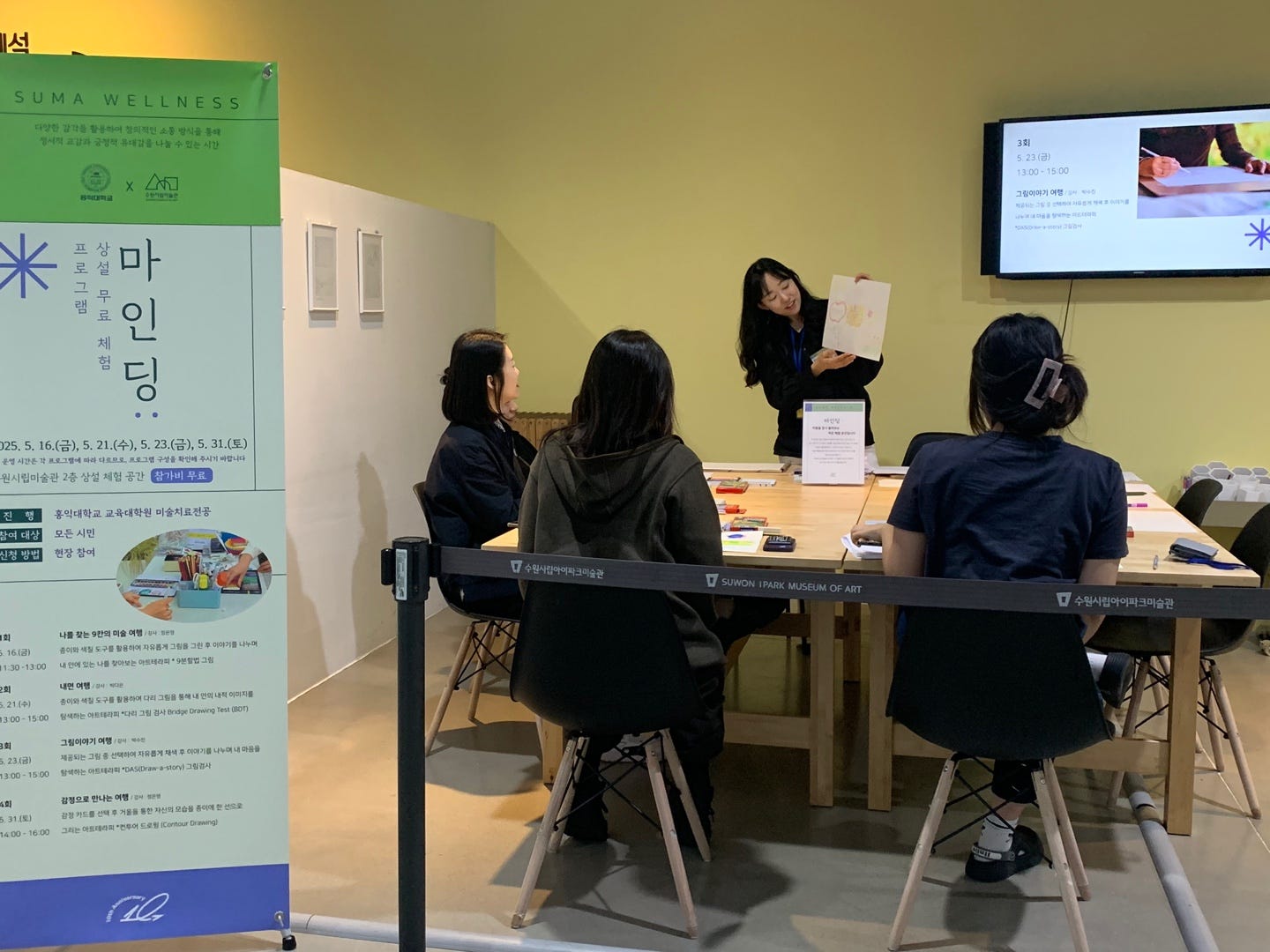
At the same time, I am actively executing practical governance so that research extends beyond academic papers into live community settings. Based on my doctoral research, a collaborative project among Hongik University (Art Therapy Major & Public Design Research Center), Suwon City, and the Suwon Museum of Art entered its second year following an agreement in April 2025, operating stably while advancing toward a refined social prescribing model.
In particular, this autumn, at the request of Suwon City’s Care Policy Division, the project expands to target ‘single-person households’—including young and middle-aged adults vulnerable to social isolation—to prevent depression and promote emotional well-being through museum art therapy. Driven once again by a multidisciplinary co-design team, we are bringing an academically validated framework into real local welfare administration, continuously shaping it into a sustainable public service.
Christensen: What advice would you give to students who want to work in this field but cannot find precedents in their home countries?
Joo: When I first started down this path, I did not begin with a grand sense of mission or lofty plans. I simply wanted to address realistic questions: “Could a wonderful space like a museum bring comfort to more people?” and “How can we help people step outside their homes, hospitals, welfare centers, and therapy rooms to meet others and experience a space of communication?” In seeking answers and sharing thoughts with people along the way, different fields naturally intersected, giving birth to new research.
If you feel lost due to a lack of precedents in your country, I encourage you to look for people around you who share similar questions—whether they are museum educators, local social workers, or policy makers. Even without a perfect system in place, start with small conversations where you can learn to understand each other’s language.
Then, try initiating a very small-scale project. It does not require a huge budget or formal institutional agreements. Try an art therapy approach with a few people in a small space, and observe how their expressions change. Those small experiences will accumulate into practical clues pointing toward your next step.
Precedents are not given from the start; they are forged step by step as we empathize with real-world needs and take modest action. You might feel anxious when the path ahead isn’t immediately visible. But if you stay true to your questions and take one step at a time, you will eventually find yourself walking alongside colleagues and companions headed in the same direction.
I will be cheering you on from Korea. Thank you.
Thank you for reading. I am grateful to Hana Joo for the time, care, and thought she gave to these responses, and for making them available to readers in both Korean and English.
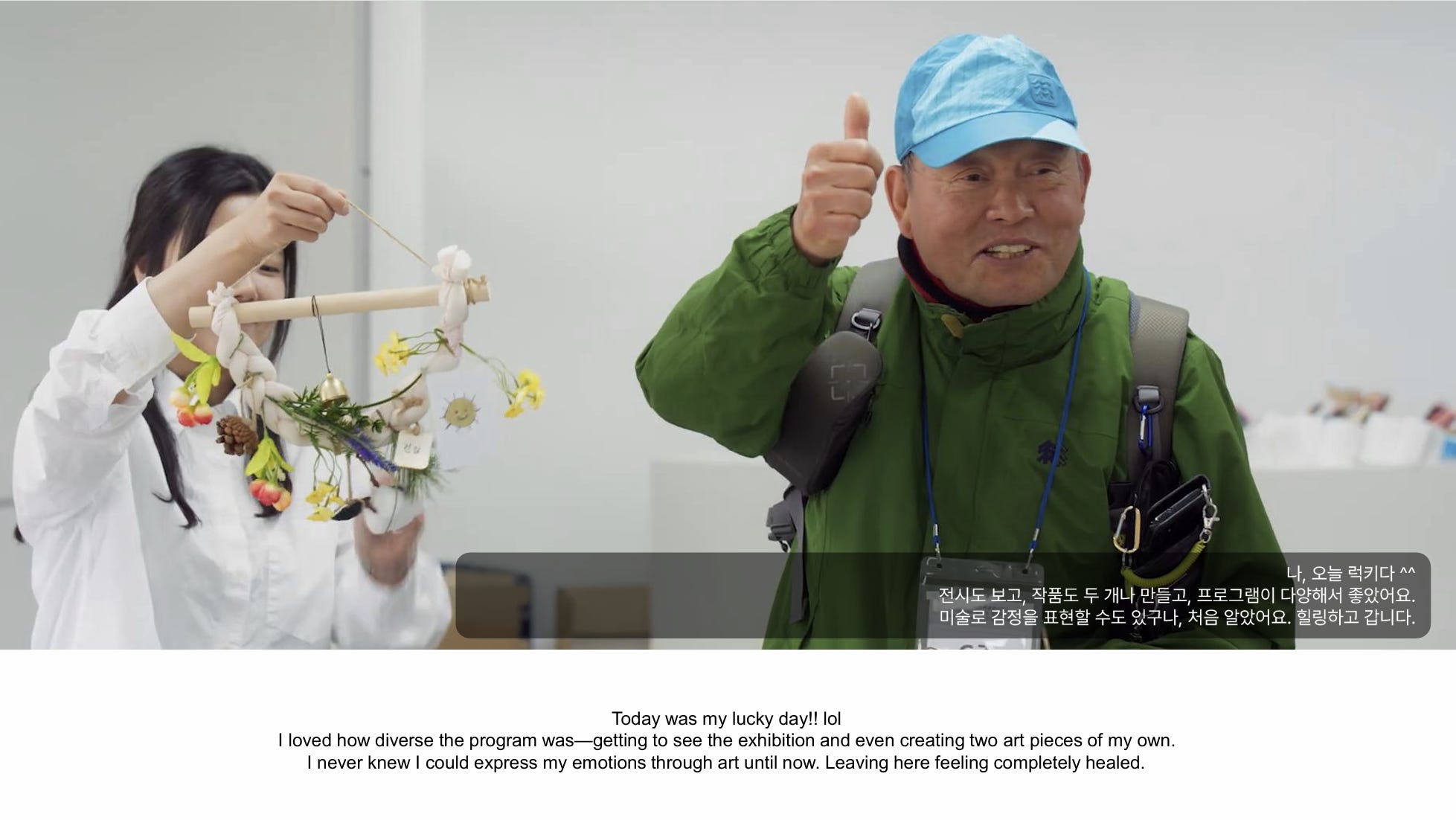
미술관을 처방하다
미술치료사이자 디자이너인 주하나 선생님과의 서면 인터뷰. 박사 연구를 통해 한국의 뮤지엄 기반 사회적 처방 모델을 설계했습니다.
이 인터뷰는 미술치료가 치료실 밖, 즉 미술관과 공공기관, 그리고 함께 나누는 문화 공간 안에서 어떻게 살아 있는지를 살펴보는 연재 시리즈의 일부입니다. 이 시리즈의 목표 중 하나는 국제적인 목소리를 소개하는 것입니다. 뮤지엄 기반 미술치료와 뮤지오테라피 프로그램은 현재 미국보다 해외에서 더 폭넓게 자리 잡은 경우가 많기 때문입니다.
이번 대화는 서울에서 활동하는 미술치료사이자 디자이너인 주하나 선생님과 나누었습니다. 홍익대학교 교육대학원에서 미술치료를, 서울여자대학교에서 서비스디자인을 가르치고 있으며, 박사 연구를 통해 뮤지엄 기반 사회적 처방의 운영 모델을 설계했습니다. 이 프레임워크는 현재 홍익대학교와 수원시, 수원시립미술관의 협력 프로젝트로 운영되고 있습니다.
공공 공간 안에 돌봄을 설계하는 일에 관한 대화입니다. 즐겁게 읽어 주시기 바랍니다.
브룩 크리스텐슨: 미술치료를 전공하신 후 홍익대학교에서 디자인 박사과정을 밟으셨습니다. 흔한 경로는 아닌데요, 이 연구를 ‘디자인’이라는 틀로 풀어가야겠다고 생각하신 계기가 무엇이었는지 궁금합니다.
주하나: 사실 홍익대학교에서 학부과정으로 디자인을 전공하며 사용하는 사람들의 이해와 분석을 배우면서, 어떻게 하면 진정 사회 환경 속 사람들의 마음과 행동을 이해하고 도울 수 있을지 고민했습니다. 그러다 보니 저의 여정은 미술치료사로서 내담자의 내면을 다루는 과정으로 연결되었습니다. 그렇게 인간의 심리와 표현예술을 통한 치유 과정을 깊이 탐구했습니다. 디자이너에서 미술치료사의 역할까지 수행하다 보니, ’치료실이라는 닫힌 공간 밖에서도 포용적이고, 다양성 존중을 실천하는 안전한 치유적 환경(Holding Environment)을 구축할 수 있을지’에 대한 통합적 연구로 이어지게 되었습니다. 저에게 있어서 디자인과 미술치료는 결코 분리된 각기 다른 영역이 아닌 것입니다.
[Figure 1]에서 보듯, 라포 형성(탐색) - 문제 정의 - 치료적 개입 및 매체 적용(실행) - 통찰과 승화(의미 통합)로 이어지는 미술치료의 다이내믹은 디자인 프로세스와 정확히 1:1로 대응합니다. 결국 미술치료가 한 개인의 미시적 치유를 다룬다면, 디자인은 그 치유의 장을 공공의 영역으로 확장해 주는 훌륭한 언어이자 틀이 되어줍니다.
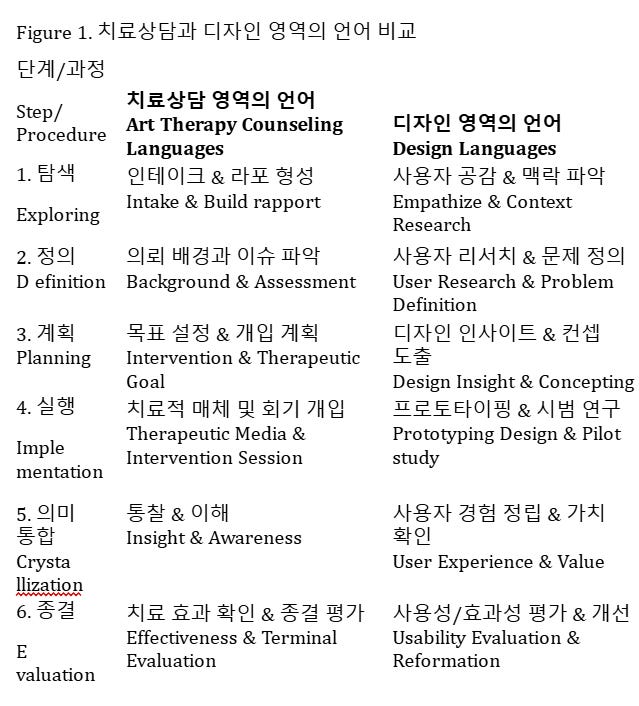
다시 말해, 치료 장면 속에서 미술치료사가 내담자의 감정을 담아내는 치료적 용기(Therapeutic Container)의 역할을 한다면, 디자인은 그러한 치유적 경험이 박물관이나 지역사회라는 공공 공간 속에서 안전하게 일어날 수 있도록 공간, 매체, 동선, 역할, 관계뿐 만 아니라, 지역사회 참여, 정책 등등 총체적인 프레임(Holistic Frame)을 제공하여 수행을 돕는 것입니다.
크리스텐슨: 이 작업이 일회성 프로그램이 아니라 공공서비스로 작동할 수 있겠다고 확신하게 된 특정한 순간이나 참여자와의 경험이 있으셨나요?
주하나: 2010년 뉴욕 퀸즈뮤지엄(Queens Museum)에서 수퍼바이저 미셸(Michelle), 동료 미트라(Mitra)와 함께 발달장애 아동 및 가족을 위한 뮤지엄 미술치료 프로그램을 함께 기획하고 운영할 때 생각이 발화하기 시작했습니다. 미술관이라는 열린 공간에서 예술 매체를 매개로 치료 환경에서 벗어난 아이들과 부모가 심리적 안정감을 느끼고 소통하는 모습을 보며 뮤지엄에 잠재된 치유적 환경의 가능성을 확인할 수 있었습니다.
이어서 그 경험은 2015년 한국 국립현대미술관(MMCA)에서 치매 어르신과 가족, 돌봄자를 위해 기획한 <공유공감> 프로젝트에서 더욱 확고해졌습니다. 현장에서 목격한 것은 작품과 예술 매체만이 치유저인 것이 아니라 사람과 사람이 만나는 관계적 힐링 그 차체였습니다.
“미술관이 생전 처음인데, 나 같은 사람도 이렇게 환영을 받고, 예술을 통해 내 이야기를 표현할 수 있어서 참 따뜻합니다.” (참여 어르신)
“어머니의 행동 변화로 늘 긴장 속에서 살았는데, 미술관에서 작품을 보고 함께 무언가를 만들며 환하게 웃으시는 모습을 보니 저 역시 마음의 짐을 내려놓고 위로를 받았습니다.” (가족/돌봄자)
특정 대상만을 위한 것이 아닌, 누구나 함께할 수 있는 문화적 존엄성이 보장되는 뮤지엄이라는 환경에서 참여자들은 환자가 아닌 ‘예술을 향유하고 만들어가는 주체’가 되었습니다. 이처럼 예술을 통한 정서적 연결과 치유의 경험이 단발성 이벤트로 끝나지 않고, 참여자들의 일상적 삶에 지속적 안전망으로 작용하려면 체계적인 공공 서비스의 형태를 갖추어야 한다고 확신하게 되었습니다.
크리스텐슨: 사회적 처방은 영국과 캐나다에서는 오래 논의되어 왔지만 한국에는 비교적 최근에 도입되었습니다. 언어의 번역을 넘어, 이 개념이 한국의 제도 안에서 이해되기 위해 개념적으로 어떤 ‘번역’이 필요했다고 보시나요?
주하나: 영국의 NHS 기반 사회적 처방을 한국에 적용하기 위해서는 ‘임상적 처방’ 개념을 ‘지역사회 기반의 연결 및 일상적 돌봄 개입’으로 재해석하는 작업이 필요했습니다.
미국과 영국의 미술치료사들도 잘 알다시피, 의료 모델 중심의 ‘처방’이라는 단어는 자칫 대중에게 질환이나 치료에 대한 부담감, 즉 사회적 낙인을 경험할 수 있습니다. 특히 한국 사회에서는 정신건강 문제로 병원이나 상담소를 찾는 것에 대해 심리적 문턱과 거부감이 과거에 비해 낮아졌을지는 몰라도, 여전히 높습니다.
따라서 우리는 사회적 처방을 ‘의사가 내리는 의료적 지시’로 다루기보다, 미술관이라는 일상적이고 아름다운 공간에서 미술치료적 기법과 매체를 활용한 정서적 안녕을 도모하는 ‘지역사회 중심의 미술치료(Community Art Therapy)’의 프레임으로 번역했습니다.
보건소·복지관과 공공 미술관이 협력하여 특정 공간에만 머물렀던 내담자가 자연스럽게 문화예술적 치유 과정으로 들어오도록 유도한 것입니다. 치료적 주체성을 내담자와 지역사회에 돌려주는 이 구조적 전환이 한국 기관들과 대중을 설득하는 핵심 열쇠였습니다.
크리스텐슨: 선행연구 분석 결과, 기존 사회적 처방 연구의 절반 이상이 65세 이상 고령층에 집중되어 있었습니다. 선생님께서는 의도적으로 청년층에 주목하셨는데, 이 전환이 왜 시급하다고 느끼셨는지 말씀해 주시겠어요?
주하나: 미술치료사로서 제가 청년층에게 집중한 이유는, 청년기가 겪는 심리적 고립과 정서적 혼란의 깊이에 비해 이들이 가진 ‘치료적 저항’과 ‘또래의 낙인에 대한 공포’가 가장 높은 집단이기 때문입니다.
고령화 사회에서 대부분의 보건·복지 자원이 고령층에 집중되는 동안, 정서적 고립과 우울, 자살 위험에 노출된 청년들은 치료의 사각지대에 방치되어 있었습니다. 청년기는 자아 정체성을 확립하고 사회적 관계를 형성해야 하는 중요한 발달적 과업을 안고 있지만, 경쟁과 고립 속에서 자신의 감정을 인식하고 조절하는 정서적 리터러시(Emotional Literacy)를 훈련받을 기회가 부족했습니다.
또한 청년들은 미래에 건강한 사회를 유지할 주체가 되는 그룹이기 때문에 제때에 도움요청을 할 수 있도록 미연에 자신을 돌보고 관리할 수 있는 사전 교육이 필요하기 때문입니다. 그래서 이들에게 중요한 것은 병원 방문 이전의 ‘예방적 치유 개입’으로 판단했습니다. 미술관이라는 감각적이고 비위협적인 공간에서 비언어적·상징적 매체로 자신의 내면을 안전하게 표현하고 정서를 조절할 수 있는 장을 제공하는 것—이것이 청년층의 정신건강 위기를 다루는 가장 시급하고 효과적인 미술치료적 접근이 됩니다.
크리스텐슨: 심리척도 및 투사적 그림검사와 함께 타액 코르티솔 검사를 병행하셨습니다. 생리적 지표가 척도만으로는 말할 수 없었던 어떤 근거를 제공해 주었나요?
주하나: 미술치료 평가에서 생리적 지표(타액 코르티솔), 심리 척도(자기보고식), 그리고 투사적 그림검사(PPAT/DAPR) 등)를 함께 활용한 것은 연구자이자 임상가로서 ’데이터 삼각측정’으로 객관적 결과를 얻고자 함이었습니다. 생리적 지표는 자기보고식 척도가 가진 한계와 사회적 타당성 편향을 객관적으로 보완해 주었습니다.
한국 문화권에서는 평가자나 연구자에게 긍정적인 결과를 보여주려는 경향이 종종 나타납니다. 실제로 한 참여자는 사후 지각된 스트레스 척도(PSS)에서 스트레스가 크게 감소했다고 응답했습니다. 그러나 타액 코르티솔 수치는 오히려 상승했고, 투사적 그림검사에서는 대처 자원이 축소되거나 인물의 이목구비가 생략되는 등 정서적 위축이 관찰되었습니다. 투사적, 생리적 데이터의 교차 검증이 없었다면 이 참여자의 결과를 ‘효과가 있는’으로 오인했을 것입니다. 결국 다각적 분석을 통해 이 참여자를 ’단기 개입으로는 효과가 미비한 그룹’에 두고 향후 개입의 방향을 고려할 수 있었습니다.
더불어, 생리적 지표는 코르티솔 상승을 단면적으로 ‘스트레스 증가’로만 해석하는 오류를 막아주었습니다. 한국 성인의 동시간대 코르티솔 기준치 데이터와 교차 비교한 결과, 적정 범위 내에서의 코르티솔 상승은 단순한 스트레스가 아닌 ‘긍정적인 생활 활력(Arousal)’을 의미하는 것으로 파악되었습니다.
이 생리적 활성화는 그림검사에서 인물의 표현력이 풍부해지고 주변 환경 및 타인과의 관계적 요소가 확장된 점과 정확히 일치했습니다. 즉, 생리적 지표는 미술치료적 개입이 내담자의 신체-정서 시스템에 실제 어떤 역동을 일으켰는지 객관적으로 입증하는 단단한 근거가 되어 연구결과를 다각도로 측정하는 것이 결과를 정확하게 분석할 수 있는 토대가 됨을 알 수 있었습니다.
크리스텐슨: 연구 결과 중 가장 예상 밖이었던 부분은 무엇이었나요? 기대와 다르게 나타난 결과도 함께 들려주시면 좋겠습니다.
주하나: 박사학위 논문에서는 1차 시범연구(대학생 30명, 아트센터 3시간)와 2차 운영연구(일반 성인 62명, 뮤지엄 협력 5회기/회기당 2시간)라는 두 번의 실증 연구를 수행했습니다. 연구 전에는 프로그램 참여 후 스트레스 감소 효과가 참여자 대부분 있을 것으로 기대했으나, 결과는 예상과 달랐습니다.
가장 놀라웠던 발견은, 두 연구 모두에서 참여자들이 뚜렷한 3가지 유형으로 분류되었다는 점입니다.
일상적 예방 그룹 : 이미 일상적 대처 능력이 양호하며, 뮤지엄을 지속적인 자기 돌봄 공간으로 활용 가능
선별적 중재 그룹 : 높은 스트레스 수준을 보였으나, 개입 후 생리적 이완과 정서적 완화 등 현저한 치료적 효과
무반응/비변화 그룹 : 단기 뮤지엄 개입만으로는 심리·생리적 변화가 미미하나, 자기이해 및 맞춤형으로 지속적 참여 권고
참여자를 단일 집단으로 보지 않고, 디자인 용어로 쓰이는 ‘사용자 페르소나’로 세분화하여 분석하고 이에 상담치료적 개입으로 예방 전략을 설계할 수 있는 소중한 발견이었습니다. 단 하나의 프로그램이 모두를 치유할 수 없다는 임상적 진실을 재확인하였으며, 그와 동시에 누구에게 일상적 문화예술을 권하고, 누구에게 보건·복지 서비스 및 전문적 돌봄을 연계할 것인가에 대한 대상자 발굴과 후속 서비스 경로(Service Pathway)를 설계하는 결정적 근거가 되었습니다.
크리스텐슨: 미술치료사 독자들을 위해 여쭙습니다. 참여자들의 그림에서 실제로 어떤 변화를 보셨나요? 수치로는 포착되지 않는 이미지의 질적 변화가 있었는지 궁금합니다.
주하나: 수치가 담아내지 못하는 ‘표현의 활력과 상징의 변화’야 말로 미술치료사들이 가장 유심히 살피는 부분일 것입니다. 임상 현장에서도 수치화된 척도에서는 포착되지 않는 미묘한 정서적 역동이 그림을 통해 선명하게 드러나곤 합니다. 특히 생리적·정서적으로 활성화된 그룹의 사전-사후 ‘빗속의 사람(DAPR)’ 그림에서 매우 현저한 질적 변화가 관찰되었습니다.
사전 그림 (Pre-test): 일부 종이 면적만을 활용하여 작고, 무표정 인물을 그리거나, 우산이나 장화 같은 대처 자원이 지극히 제한적이고 조심스러운 형태로 표현
사후 그림 (Post-test): 전체 종이 공간을 주도적 활용하며, 활짝 웃거나 우산을 들고 빗속에서 춤을 추듯 표현하는 등 우비를 입은 인물이 당당하게 서 있는 모습으로 나타남. 나아가 빗물 속의 연잎, 개구리, 물방울 등 비가 스트레스 자극이 아닌, 생명력 있는 환경으로 재해석한 상징 등장
그림에서의 이러한 공간적 확장과 유희적 상징은 참여 이후 서로 웃으며 대화를 나누고 공동체적 유대감을 즐기는 행동 관찰을 통해 정동이 일치하는 것을 알 수 있었습니다.
이러한 참여자의 질적 변화는 단순한 검사 결과를 넘어 내면에서 원하는 바가 무엇인지 보여주는 이정표가 되었고, 자신을 이해하고 주변의 관계에 관심을 갖는 계기가 되었다고 보고했습니다. 이 분석을 바탕으로 참여자 개개인에게 맞춤형 리포트를 전달하고, 일상에서 자기 돌봄을 위한 문화예술 환경과 참여 그룹에 직접 참여해볼 수 있도록 지원하였습니다.
크리스텐슨: 선생님은 뮤지엄 미술치료를 증상 완화 중심의 임상적 치료와 구별하여, 발달과 웰빙을 지향하는 개입으로 정의하셨습니다. 실제 현장에서 이 경계를 어떻게 지키시나요? 특히 세션 중에 임상적 개입이 필요한 상황이 드러날 때는 어떻게 대응하시는지요.
주하나: 정신건강의학과 임상 현장에서 미술치료사이자 수퍼바이저로 재직했고, 국립미술관과 뉴욕 퀸즈뮤지엄 등 문화기관에서도 일했습니다. 이 두 영역을 모두 경험하며 얻은 결론은, 병원과 뮤지엄이 인간의 삶에서 분절된 공간이 아니라 치유의 연속선상에 있는 환경이라는 점입니다.
홍익대학교에서 연구원 및 학생들과 뮤지엄 미술치료를 런칭할 때 한 수련생이 “뮤지엄 미술치료는 병원보다 쉬울 줄 알았는데, 막상 해보니 모든 임상과 교육 경험을 갖춘 치료사가 서야 하는 가변적이고 깊은 현장 같다”고 말한 적이 있습니다. 정확한 지적입니다. 비임상적 공간인 뮤지엄에서 발달과 웰빙을 다룬다는 것은, 임상적 깊이를 배제하는 것이 아니라 오히려 깊은 임상적 통찰을 바탕으로 현장의 유연한 경계를 설정하고 다뤄야 하는 일입니다.
실제로 오픈스튜디오 방식의 그룹 세션 중, 한 참여자가 미술 표현을 하다가 감정이 북받쳐 흘러넘치며 눈물을 터뜨린 적이 있습니다. 순간 공간에 정적이 흘렀고, 수련생은 당황하여 저를 바라보았습니다. 그때 낯선 주변 참여자가 공감하며 따뜻하게 말을 건넸습니다.
“괜찮아요. 저도 가끔은 이유 없이 눈물이 나요.”
이 순간이 바로 뮤지엄이라는 오픈된 환경이 가진 치료적 힘입니다. 치료사가 정형화된 임상적 개입으로 상황을 통제하기 전에, 뮤지엄이라는 비위협적이고 온화한 공간에서 전문적인 매개자와 참여 그룹 간 자연스럽게 형성된 안정감으로 공감을 공유하고, 이는 공동체 유대로 이끄는 것입니다.
한국 참여자들 특성이 대체로 자신을 드러내기 조심스러워하지만(모든 사람이 그렇지는 않음), 뮤지엄이라는 환경 자체가 개인이 가진 방어를 완화하는 역할을 합니다. 치료사는 개인이 가진 어려움, 증상과 치료적 개입에 머무는 것이 아니라, 돌발적인 임상적 상황이 발생했을 때 이를 안전하게 포용하되 세션이 심각한 퇴행으로 흘러가지 않도록 공간과 매체, 그리고 집단 역동의 경계를 정교하게 디자인하는 연출가가 되어야 합니다. 임상적 경계를 아는 치료사가 뮤지엄이라는 모두에게 열린 환경도 안전한 치유의 장으로 holding할 수 있습니다.
크리스텐슨: 뮤지엄 에듀케이터는 이미 뛰어난 퍼실리테이터입니다. 훈련받은 미술치료사가 더할 수 있는 고유한 역량은 무엇이며, 그 차이를 뮤지엄 실무자들에게 어떻게 설명하시나요?
주하나: 오늘날 ICOM은 뮤지엄의 정의를 포용, 다양성, 지속가능한 기관으로 정의합니다. 이에 따라 기존의 전시, 보존, 교육과 같은 학예 영역에서 새로운 정의를 실천하기 위한 전략으로 다학제적 영역과 협력하고 지역사회의 시민들이 참여할 수 있는 기회를 마련해 나가야 할 입장에 놓여 있습니다.
뮤지엄 에듀케이터는 박물관의 정체성과 전시의 교육적 가치를 깊이 이해하며, 관람객과의 소통을 이끄는 훌륭한 전문가들입니다. 훈련받은 미술치료사가 이 현장에 더할 수 있는 고유함은 ’비언어적 정서 역동을 읽어내는 임상적 감수성과 심리적 안전지대를 구축하는 역량’입니다.
에듀케이터가 전시 콘텐츠를 매개로 관람객의 지적·감각적 확장을 돕는 퍼실리테이션으로 주역할을 한다면, 미술치료사는 참여자의 수줍음, 침묵, 미세한 저항이나 정서적 표출 뒤에 숨겨진 미묘한 심리적 신호를 포착합니다. 작품을 감상하거나 창작하는 과정에서 유발될 수 있는 무의식적 감정이나 취약성이 드러났을 때, 이를 안전하게 반영하면서 정서적 안정감을 유지하는 것이 미술치료사의 전문성입니다.
뮤지엄 실무자들에게 이 차이를 설명할 때, 저는 두 영역이 대립하는 것이 아니라 ’관람객의 안녕을 위한 하나의 연속선(Continuum) 상에 있는 파트너십’임을 강조합니다.
미술치료사는 교육의 영역을 대체하러 온 것이 아닙니다. 에듀케이터와 미술치료사가 협력할 때, 뮤지엄은 그저 ‘지식 이해와 감상의 공간’을 넘어 정서적 치유와 인격적 성장이 일어나는 ‘통합적 치유 유대 공간’으로 그 외연을 확장할 수 있습니다.
크리스텐슨: 델파이 조사를 통해 22개의 운영 요소가 최종 도출되었습니다. 전문가 패널 사이에서 가장 이견이 컸던 요소는 무엇이었고, 그 의견 차이는 어떻게 조율되었나요?
주하나: 델파이 조사를 통해 뮤지엄 기반 사회적 처방에 필요한 22가지 운영 요소를 도출하는 과정에서, 전문가 그룹(미술치료사, 뮤지엄 학예사, 서비스 디자이너, 보건·복지 행정가)이 가장 이견이 컸던 지점은 ’참여자 공동 설계(Co-design)’와 ’이종 부처 간 협력 양해각서(MOU) 체결’이라는 두 가지 요소였습니다.
첫째, 참여자 공동 설계(Co-design)에 대한 이견입니다. 서비스 디자인에서는 사용자의 요구를 반영한 co-design이 필수적이지만, 임상 전문가들은 전문적 치료 구조나 개입 프레임워크가 약화되어 치료적 효과성이 떨어질 수 있다는 우려를 제기합니다.
이러한 담론은 공동 설계를 ‘치료적 개입의 모든 것을 내담자에게 맡기는 것’이 아니라, ‘참여자의 신체적·정서적 접근성, 선호하는 매체 및 환경적 요구를 사전 파악하여 개입의 구조를 세심하게 다듬는 프로세스(Scaffolding)’로 재정의함으로써 공동의 이해를 도모할 수 있었습니다. 임상적 프레임워크의 단단함 위에 서비스 디자인의 사용자 중심 가치를 유연하게 결합할 필요가 있는 것입니다.
둘째, 지역사회 보건·복지 기관과의 행정적 연계(MOU 및 협력 체계)입니다. 전문가들 모두 다학제적 협력의 필요성에는 100% 동의했으나, 현실적으로 교육, 임상, 보건의 행정 장벽(Silo) 때문에 공공 현장에서 체계적인 MOU 체결과 협력이 가능하겠는가’라는 실행 가능성에 큰 의문이 제기되었습니다.
이 문제는 단번에 거대한 제도적 협약을 맺으려 하기보다, ‘프로젝트 기반의 유연한 협력 거버넌스’를 단계적 가이드라인으로 제시하여 해법을 찾아가는 중입니다. 거시적 행정 절차에 매이기보다 현장 중심의 파일럿 사업을 통해 성공 사례를 만들고, 이를 바탕으로 지자체 복지 정책과 연계해 나가는 실용적 접근법으로 운영체계를 반영하고 있습니다.
크리스텐슨: 국공립 뮤지엄과 사립 뮤지엄 각각에 맞는 운영 모델을 제안하셨습니다. 직원이 두 명이고 건강 관련 사업 예산이 없는 소규모 사립 뮤지엄에서는 이것이 어떤 모습으로 구현될 수 있을까요?
주하나: 상주 직원이 2명뿐이고 건강·복지 관련 자체 예산이 없는 소규모 사립 뮤지엄이라도, ’지역사회 에코시스템(Ecosystem)을 활용한 자원 연계 모델’을 적용하면 충분히 뮤지엄 미술치료 및 사회적 처방을 구현할 수 있습니다. 자체 자원을 짜내는 방식이 아닌, 외부 기관과의 상생적 네트워크를 디자인하는 것입니다. 소형 뮤지엄을 위한 실행 전략은 크게 세 가지 축으로 작동합니다.
대학 인턴십 및 실습 파이프라인의 전문 인력 수급: 지역 대학의 미술치료 대학원 및 관련 학과와의 업무협약 체결 방안. 임상 및 지역사회 실습 수련이 필요한 예비 미술치료사들을 뮤지엄 프로그램의 운영 인력으로 연계하면서, 뮤지엄은 전문성을 갖춘 인력을 확보하고 대학은 훌륭한 현장 수련 기관을 확보
기업의 ESG 및 CSR/CRV 펀딩 활용으로 예산 확보: 오늘날 기업들이 지역사회 정서 복지나 문화 소외계층 지원 등 ESG 경영 성과를 위해 다양한 사회공헌 예산 집행. 사립 뮤지엄은 공간과 전시 자원을 제공하며, 기업의 후원을 유치하여 프로젝트성 건강·치유 프로그램 기획
지역 복지관 및 보건소의 아웃리치 연계의 대상자 모집: 자체 관람객 모집이 어려운 경우, 이미 대상자 네트워크를 보유한 지역 정신건강복지센터, 치매안심센터, 종합사회복지관의 아웃리치 프로그램과 결합 방식. 복지 기관의 이동 및 인솔 지원을 통한 뮤지엄 공간을 치유 장소로 공유.
소규모 사립 뮤지엄의 강점은 빠른 의사결정과 특유의 친밀한 환경성입니다. 거대한 예산이 없더라도 ‘지역사회 거점 치유 공간’이라는 서비스 프레임을 적용한다면, 작은 뮤지엄이야말로 대중이 문턱 없이 찾을 수 있는 가장 따뜻한 일상적 치유 거점이 될 수 있습니다.
크리스텐슨: 선생님의 프레임워크를 접하는 미국이나 유럽의 독자들에게, 한국적 맥락 중 그대로 옮겨질 수 없고 단순히 복제해서도 안 되는 부분은 무엇이라고 말씀하시겠어요?
주하나: 서구(특히 북미나 영국)와 한국의 환경에서 가장 크게 다른 점은 ’행정 및 재정 구조(Governance & Funding)’와 ’정신건강 서비스에 접근하는 시점’입니다. 따라서 한국 모델의 행정 절차나 정책 방식을 그대로 복제하기보다는, 각 국가의 문화적·제도적 토양에 맞추어 재해석해야 합니다.
첫째, 탑다운(Top-down)과 바텀업(Bottom-up)이 결합된 거버넌스 구조입니다. 미국이나 유럽은 기부 문화, 민간 재단 펀딩, 혹은 NHS처럼 제도화된 보건 체계를 바탕으로 현장 중심의 자율적 시도가 활발합니다. 반면 한국은 지자체의 공공디자인 및 문화복지 정책, 지자체 예산 체계와 긴밀히 연동된 ‘공공 이니셔티브’가 동반되어야 지속 가능성을 확보할 수 있습니다. 민간 기부나 1차 의료 중심의 자원 전달 체계가 발달한 서구에서 한국의 지자체 연계형 행정 모델을 그대로 이식하는 것은 현실과 맞지 않을 수 있습니다.
둘째, 정신건강 개입에 도달하는 경로(Direction of Entry)입니다. 영국의 사회적 처방이 1차 의료(GP)에서 시작되어 지역사회 문화 자원으로 외연을 확장하는 ‘의료에서 출발한 연계’라면, 한국 모델은 정신건강 치료에 대한 사회적 낙인(Stigma)과 의료보험 수가와 같은 문화적이고 행정 제도적 특성을 고려했습니다. 병원 방문 이전 단계에서 미술관이라는 비임상적 공공 공간을 통해 먼저 정서적 문턱을 낮추고, 필요시 치료나 복지로 연결하는 ‘일상에서 시작하는 마중물’ 역할을 하도록 설계되었습니다.
결국 서구 독자들이 한국 프레임워크에서 취해야 할 것은 특정한 행정 양식이 아니라, 미술치료적 정서 안전망을 공공 공간의 서비스 프로세스와 결합해 낸 ‘통합적 설계 원리’입니다. 각자의 국가가 가진 보건·문화 시스템의 특성에 맞게 프레임을 재구성하는 유연성이 필요합니다.
크리스텐슨: 논문을 마치신 지금, 어떤 작업을 준비하고 계신가요?
주하나: 박사학위 논문을 마친 후 저의 작업은 크게 ‘학문적 공유와 교육’ 및 ’현장 중심의 실천적 확장(Real-world Implementation)’이라는 두 가지 축으로 이어지고 있습니다.
우선 모교인 홍익대학교 교육대학원에서 석·박사 과정 미술치료 강의를, 서울여자대학교 글로벌융합전공에서 서비스디자인 강의를 맡아 학생들을 만나고 있습니다. 개인적으로는 디자인과 미술치료의 융합을 통해 사회적 가치를 창출해 나갈 미래 연구자와 실무자들을 양성하는 데 주력하고 있습니다. 또한 그동안 한국 현장에서 미술치료사이자 디자이너로서 겪었던 시도와 고민, 데이터들을 통합적인 시각으로 풀어낸 단행본 출간 준비를 위해 글을 쓰고 있습니다.
동시에 연구가 논문 안에만 머물지 않고 현장에서 생명력을 갖도록 실천적 거버넌스를 적극적으로 수행하고 있습니다. 박사 연구를 바탕으로 구축된 홍익대학교(미술치료전공 및 공공디자인연구센터) - 수원시 - 수원시립미술관 간의 협력 프로젝트가 지난해(2025년) 4월 협약 체결 이후 현재 2년 차에 접어들어 안정적이 되면서, 좀 더 사회적 처방 개념으로 고도화하여 운영하고 있습니다.
특히 올 가을에는 수원시 돌봄정책과의 요청으로 대상층이 확대되어, 청년 및 중장년층을 포함해 사회적 고립 위험에 노출되기 쉬운 ‘1인 가구’의 우울 예방과 정서적 안녕을 위한 뮤지엄 미술치료 프로젝트를 다시 한 번, 다학제적 팀이 공동디자인으로 추진할 예정입니다. 학술적 검증을 마친 프레임워크가 실제 지자체의 복지 행정과 만나 지속 가능한 공공서비스로 정착해 가는 과정을 현장에서 또 한번 협력하며 새롭게 만들어가고 있습니다.
크리스텐슨: 이 분야에서 일하고 싶지만 자국에 아직 선례를 찾기 어려운 학생에게 어떤 말씀을 해 주시고 싶으신가요?
주하나: 제가 이 길을 처음 시작할 때 대단한 사명감이나 거창한 계획이 있었던 것은 아니었습니다. 그저 ‘미술관이라는 좋은 공간이 더 많은 사람에게 위로가 될 수도 있지 않을까?’, ‘어떻게 하면 집, 병원, 복지관, 치료실 밖으로 나와 사람들과 만나며 소통의 장으로 경험하게 할 수 있을까?’라는 현실적인 고민에 답을 찾고 문제를 풀고 싶었습니다. 그 질문에 답을 찾아가며 사람들을 만나고 고민을 나누다 보니, 자연스럽게 여러 영역이 만나고 새로운 연구도 시작하게 된 것 같습니다.
만약 자국에 선례가 없어 막막함을 느끼고 있다면, 먼저 나와 비슷한 고민을 하는 주변의 사람들을 찾아보시길 권합니다. 그것이 미술관 에듀케이터일 수도 있고, 지역 사회복지사나 정책 담당자일 수도 있습니다. 완벽한 제도가 없더라도 서로의 언어를 이해하며 나눌 수 있는 작은 대화부터 시작해 보세요.
그리고 당장 할 수 있는 아주 작은 규모의 프로젝트부터 시도해 보세요. 거창한 예산이나 기관 간의 공식적인 협약이 아니더라도 괜찮습니다. 내가 만날 수 있는 몇 명의 사람들과 작은 공간에서 미술치료적 접근을 시도해 보고, 그분들의 표정이 어떻게 변하는지 관찰해 보는 겁니다. 그 작은 경험들이 쌓여 다음 단계로 나아갈 수 있는 현실적인 힌트가 될 것입니다.
선례는 처음부터 주어지는 것이 아니라, 현장의 필요에 공감하고 작은 발걸음을 떼는 과정에서 조금씩 만들어지는 것 같습니다. 당장 눈앞에 길이 보이지 않는다고 조급해질 수도 있을 거에요. 하지만 스스로의 질문에 충실하며 한 걸음씩 걷다 보면, 어느새 비슷한 방향을 향해 걷는 동료와 사람들을 만나게 되는 시간이 주어지는 것 같습니다.
저 역시 한국에서 여러분을 응원하겠습니다. 고맙습니다.
읽어 주셔서 감사합니다. 귀한 시간과 깊은 생각을 나누어 주시고, 한국어와 영어 두 언어로 독자들을 만날 수 있도록 해 주신 주하나 선생님께 감사드립니다.
