This interview is part of an ongoing series exploring how art therapy lives beyond the clinic, such as inside museums, public institutions, and shared cultural spaces. A central aim of this series is to foreground international perspectives, particularly from contexts where museum-based art therapy and museotherapy are more structurally embedded within academic, clinical, and public health systems than they currently are in the United States.
For this conversation, I spoke with Maria Büter, a research associate and clinical art therapist at the Sigmund Freud University Berlin. Her work is part of Opening Up New Spaces with Art Therapy in Museums, a program that brings psychodynamic and receptive art therapy approaches into museum settings through structured workshops, research initiatives, and clinical training.
What follows is a conversation about museums as functional partners in mental health work. About prevention rather than crisis. About structure without clinical framing. And about what art therapy can look like when it meets people where they already are.
Please enjoy this written interview!
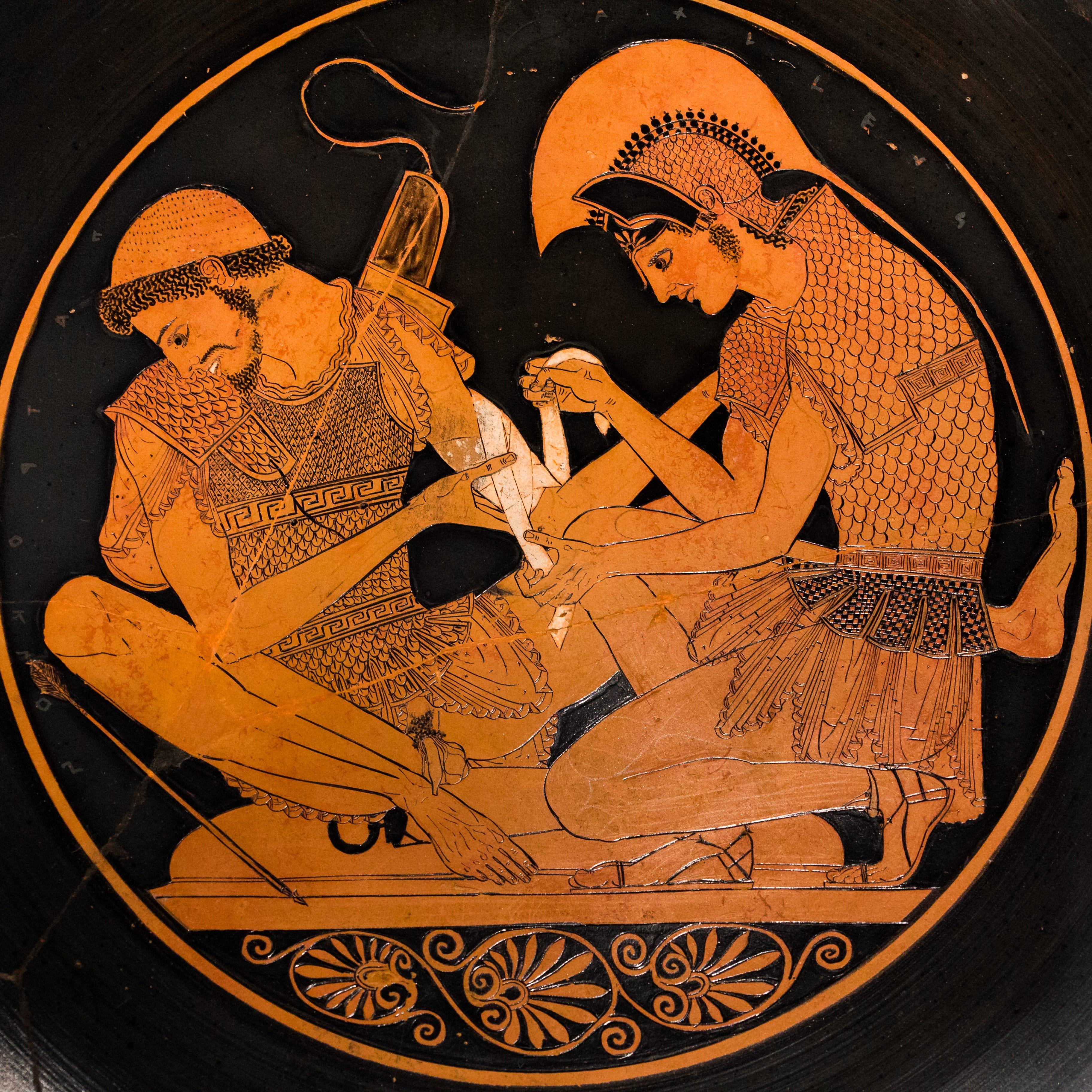
Illustration on the interior of a Greek kylix, Achilles dressing the wounds of Patroclus, Attic red figure, Vulci, Italy, ca. 500 BC, signed by the potter Sosias © Staatliche Museen zu Berlin, Antikensammlung / Johannes Laurentius
Brooke Christensen: How did the Art Therapy in Museums project originate at SFU Berlin, and what theoretical or clinical ideas inspired it?
Maria Büter: The project originated at SFU Berlin at the intersection of clinical experience, academic teaching, and a growing interest in preventive formats beyond classical psychotherapy. Within the Department of Psychotherapy Science and the Clinical Art Therapy program, we repeatedly encountered students and patients who were psychologically burdened but not necessarily in need of—or ready for—clinical treatment.
It began with a simple curiosity: What happens when you take therapy out of the clinic and into a museum? We were inspired by psychodynamic ideas—how people project, reflect, and find meaning—and wondered how artworks could catalyze these processes. Clinically, we were drawn to the idea that museums might offer a safe yet stimulating environment for emotional exploration and self-expression. The first project by the SFU of this sort was actually conducted in Celle in 2019, where students were able to carry out diverse workshops, combining art therapy and museum education.
At the same time, SFU Berlin has a strong foundation in receptive art therapy, which focuses on aesthetic experience, inner imagery, and symbolic resonance rather than artistic production alone. The collaboration with the Altes Museum and the Antikensammlung of the Staatliche Museen zu Berlin provided a unique opportunity to translate these theoretical concepts into an embodied, real-world practice. From the beginning, the project was conceived both as a research initiative and as a structured workshop series closely linked to teaching and training at SFU Berlin.
Christensen: In your view, what distinguishes a museum setting as a therapeutic environment compared to a traditional clinical one?
Büter: Museums are special because they are public yet contemplative. They offer a rich symbolic world in which people can explore, reflect, and connect—without the walls or expectations of a therapy room. Entering a museum does not mean becoming a patient; it means engaging with art.
This shift is crucial. In the museum, it is less about “being treated” and more about discovering something about oneself in dialogue with an artwork. In our workshops at the Antikensammlung in the Altes Museum, this difference is immediately tangible. Participants encounter artworks in a calm atmosphere that supports slowness and openness.
The museum becomes a shared external space where inner experiences can emerge indirectly, through engagement with art rather than through direct self-disclosure. This significantly lowers psychological thresholds and supports participation motivated by curiosity, reflection, and self-care rather than pathology.
Christensen: What psychological or psychodynamic processes do you observe emerging uniquely within museum spaces?
Büter: We observe projection and transference in a particularly vivid way. People often relate personally to artworks, and this relationship sparks reflection, insight, and emotional movement. Through receptive engagement, inner images, memories, and associations emerge spontaneously—they are not imposed, but discovered.
Works of art offer a subjective space for experience in which emotional effects can develop and a psycho-aesthetic experience becomes possible. In modern art psychology, works of art are characterized by self-preservation, self-transformation, and self-catalysis. All of this happens through the radiation of the energy that was once formed into it by the artists.
The museum context also enhances symbolic distancing. Artworks act as mediators between inner and outer reality, allowing participants to speak about an artwork and, through that, indirectly about themselves. This facilitates affect regulation, reflection, and the development of an individual aesthetic standpoint.
In group settings, there is also a communal dimension: participants resonate with one another’s interpretations, creating shared meaning. This collective resonance supports emotional growth while respecting individual boundaries.
Christensen: Could you describe a specific collaboration between SFU and a museum that felt particularly transformative?
Büter: The ongoing collaboration with the Altes Museum and the Antikensammlung has been particularly transformative because it brings together research, teaching, and public engagement. The workshop series functions not only as a research project but also as a binding educational format for SFU students, with the possibility of practicum recognition.
At the same time, we have witnessed deeply moving moments in earlier collaborations, including with contemporary art collections. In one workshop, a participant who had great difficulty expressing emotions verbally found a way to communicate grief through responding artistically to an abstract artwork. Experiences like these reveal the museum as a catalyst for emotional and creative breakthroughs.
For participants, engaging in a structured, recurring group within a museum often leads to a new sense of belonging—both to the group and to the cultural space itself. For us as clinicians and educators, these collaborations have fundamentally reshaped our understanding of museums as active partners in mental health promotion rather than passive venues.
Christensen: What challenges arise when translating clinical frameworks into public or educational museum contexts?
Büter: One of the main challenges is balancing openness with safety and structure. Museums are not controlled environments like clinics—there are visitors, movement, and distractions—yet therapeutic processes still require containment.
A central concern is maintaining therapeutic clarity without transforming the museum into a clinical space. Our workshops are explicitly framed as health-promoting group offerings, not psychotherapy. This requires careful language, transparent communication, and a clearly structured format.
Another challenge lies in interdisciplinary collaboration. Museum professionals primarily work within educational frameworks, while clinicians focus on psychological processes. Ongoing dialogue and shared planning are essential. We address these challenges through fixed group sizes, mandatory participation, and a clearly defined workshop sequence that allows both freedom and containment.
Christensen: How do you navigate confidentiality, containment, and boundaries in spaces that are both public and therapeutic?
Büter: From the outset, we are very clear with participants about confidentiality, respectful interaction, and the limits of the setting. We create physical and temporal boundaries by working in designated museum spaces and within defined time frames.
Group sizes are limited to around 10–12 participants, and participation is based on commitment to the full workshop series. Each session follows a consistent structure: a short guided relaxation, dialogical artwork viewing, a creative phase, and a moderated group conversation.
This structure provides psychological containment, while debriefings and reflective prompts help participants process experiences without exposing sensitive material in public. Many participants experience the museum itself as a stabilizing container—public enough to feel safe, yet structured enough to allow vulnerability.
Christensen: How do cultural and societal attitudes toward mental health in Germany and Europe shape your approach?
Büter: In Germany and across Europe, mental health is increasingly discussed, yet stigma and access barriers remain. There is also a strong cultural emphasis on privacy. For this reason, we deliberately frame our museum-based formats as creative and reflective workshops rather than therapy.
Museums enjoy a high level of social trust. Art therapy in this context makes it possible to understand mental well-being as part of everyday cultural life—and not just as a medical issue. Our approach is based on European traditions of public education and cultural participation. The integration of people with mental and physical disabilities is particularly important to us. Through barrier-free museum offerings and preventive measures, we promote inclusive access to art and culture.
By focusing on curiosity, aesthetic experience, and self-reflection, we respond to the need for low-threshold, non-stigmatizing support services.
Christensen: What might art therapists and museum professionals in the U.S. learn from the European model, and vice versa?
Büter: The European model highlights close collaboration between therapists, universities, and cultural institutions as part of preventive health strategies. This integration of art therapy into public cultural infrastructure may be particularly instructive internationally.
At the same time, U.S. programs often place strong emphasis on evaluation, measurable outcomes, and community outreach. These approaches could further strengthen European initiatives. A transatlantic exchange could help develop programs that are both deeply experiential and rigorously supported by research.
Christensen: What kinds of psychological outcomes or shifts have you observed in participants?
Büter: Participants frequently report increased calmness, emotional clarity, and a renewed sense of connection—to themselves, to others, and to art. Many gain emotional insight, creative expression, and a stronger sense of agency. Group settings often enhance social connection and empathy. Our pilot-research also showed, that participants in general felt more positive emotions (like feeling activated joyful) and less negative emotions after the workshops compared to before.
Anecdotally, moments stand out when participants articulate inner experiences through images or creative gestures that had previously remained diffuse or inaccessible. For example, individuals struggling with grief have found nonverbal ways to express their emotions through engagement with sculpture or painting. These moments often mark meaningful shifts toward self-awareness and well-being, which is why the project is accompanied by ongoing evaluation.
Christensen: Looking ahead, how do you envision the role of art therapists evolving within museums and other cultural institutions?
Büter: We see art therapists becoming integral to museums—not just leading workshops, but collaborating on exhibitions, community engagement, and education. Museums could become hybrid spaces for mental well-being, creativity, and reflection. Therapists may increasingly advocate for mental health in public spaces, expanding how people access and experience therapy.
Over the next decade, we see art therapists increasingly working as mediators between artworks and audiences. Their role will extend beyond education toward supporting reflective, inclusive, and health-promoting encounters with art.
Museums may increasingly collaborate with art therapists to develop structured programs that address well-being, inclusion, and social resilience. In this sense, art therapists contribute to opening “new spaces” within cultural institutions—spaces that care not only for collections, but for human experience.
Thank you for reading. I’m forever grateful to Maria Büter and the staff at Sigmund Freud PrivatUniversität Berlin for their openness to this interview and for the time and thought invested in these responses.